
Table of Contents

HouseCanary
Know what any property is really worth.
AVMs with a 2.7% median error, plus the comps and forecasts agents and investors rely on.
Explore PlansOverview
A CMA usually starts with forty-five minutes in the MLS: pull comps, adjust for the pool and the finished basement, build the grid. The HouseCanary MCP turns that opening into a single question. It doesn't build the CMA you hand the seller; it gives you the valuation inputs that CMA starts from. Connect it to an AI assistant and you can ask, in plain English, what a home is worth, and get back a professional-grade valuation, a confidence range, a 36-month forecast, and market rent without writing a line of code. This post walks through three homes, what came back for each, where the answer fits in the CMA you send, and the one thing the answer gives you that a consumer estimate never will: a straight read on how much to trust the number.
Key Takeaways
- The HouseCanary MCP lets an AI assistant pull a professional valuation from a plain-English question: the estimated value, a confidence range, a 36-month forecast, and market rent, with no code. It's the starting input to a CMA; the comps, adjustments, and client-ready report still come from Property Explorer.
- A consumer estimate gives you one number. A professional AVM also reports its own expected error, the confidence range, so you know whether to price on it or verify first.
- Confidence is the tell. A typical home comes back tight (about ±8%); a one-of-a-kind property comes back wide (±16.8% on a $1.25 million custom home in a ZIP with a $410,000 median), which is the model telling you to bring in your own judgment.
- The AVM is a starting point, not an appraisal, and the MCP is read-only. It does the busywork; you keep the pricing conversation and the client relationship.
What is the HouseCanary MCP?
The HouseCanary MCP lets a real estate agent ask an AI assistant a plain-English question about a home and get back a professional valuation: the estimated value, a confidence range that says how much to trust it, a 36-month price forecast, and market rent, without writing any code.
MCP stands for Model Context Protocol, the open standard that lets an assistant such as Claude or ChatGPT call outside tools. The HouseCanary MCP connects that assistant to HouseCanary's data, so it pulls live numbers instead of guessing from its training data. You ask about an address; the assistant calls HouseCanary's tools and returns the numbers. Connecting it is a one-time setup, covered in the HouseCanary MCP server guide; after that, the data comes to you inside the assistant you already use. It is the bring-your-own-assistant version of the workflows in our guide to AI agents in real estate.
Under the hood it reaches HouseCanary's valuation engine, the same one behind Property Explorer and the Data Explorer API: 136 million properties, a 2.7% median error on post-list valuations, and 36-month forecasts. The MCP exposes 149 read-only data tools spanning valuations, rent, market pulse by ZIP, home-price-index forecasts, sales and tax history, and hazard risk.
Can an AI assistant give you a home's value and confidence range?
Picture the kitchen table. The seller floats a number, and you need a better one, backed by more than an online estimate. Instead of promising a full CMA tomorrow, you ask:
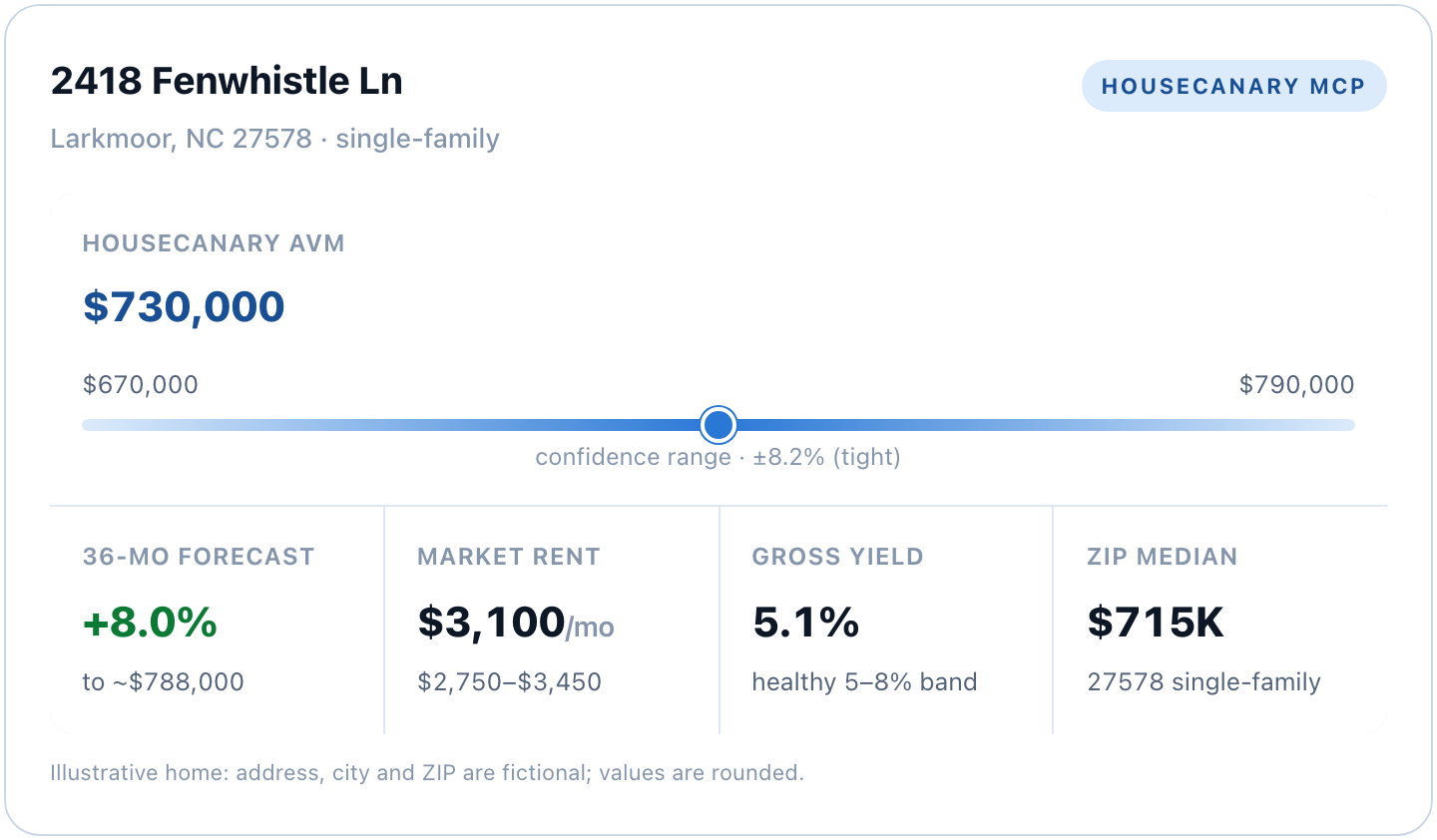
"What's 2418 Fenwhistle Ln, Larkmoor, NC 27578 worth? Give me the confidence range, market rent, gross yield, and the 36-month forecast."
The assistant runs a few HouseCanary lookups (value, rent, forecast) and comes back with the whole starting point:
- Estimated value: $730,000, with a confidence range of $670,000–$790,000 (±8.2%)
- 36-month forecast: +8.0% (to about $788,000)
- Market rent: $3,100/mo ($2,750–$3,450), a 5.1% gross yield
- ZIP median (27578): $715,000
The three homes in this post are illustrative: their addresses, cities, and ZIP codes don't exist, and every figure is rounded, so no homeowner's data appears here. What they show is how to read an answer.
That ±8.2% is the important part. It's tight, which means the model is confident, so you can walk into the appointment and price with conviction instead of hedging. The home sits close to its ZIP's median, the kind of house that sells often enough for the model to know it well. And because rent and yield came back in the same answer, you're ready for an investor buyer without opening a second tool. New to the software side of CMAs? Start with how to use a CMA tool.
How much should you trust an AI home value estimate?
A confidence range on a home value estimate is the model's own statement of how far off it might be: a band around the estimate that widens when the model has fewer comparable sales to learn from. HouseCanary's technical name for it is the forecast standard deviation (FSD). On a typical suburban home it runs about ±8%; on a one-of-a-kind home it can double. A consumer estimate shows you one number and keeps its margin of error to itself; a professional AVM reports it, so you know whether the number is tight enough to price on or wide enough that you should pull comps and verify.
Ask the MCP the same question about three homes and the ranges come back very differently.
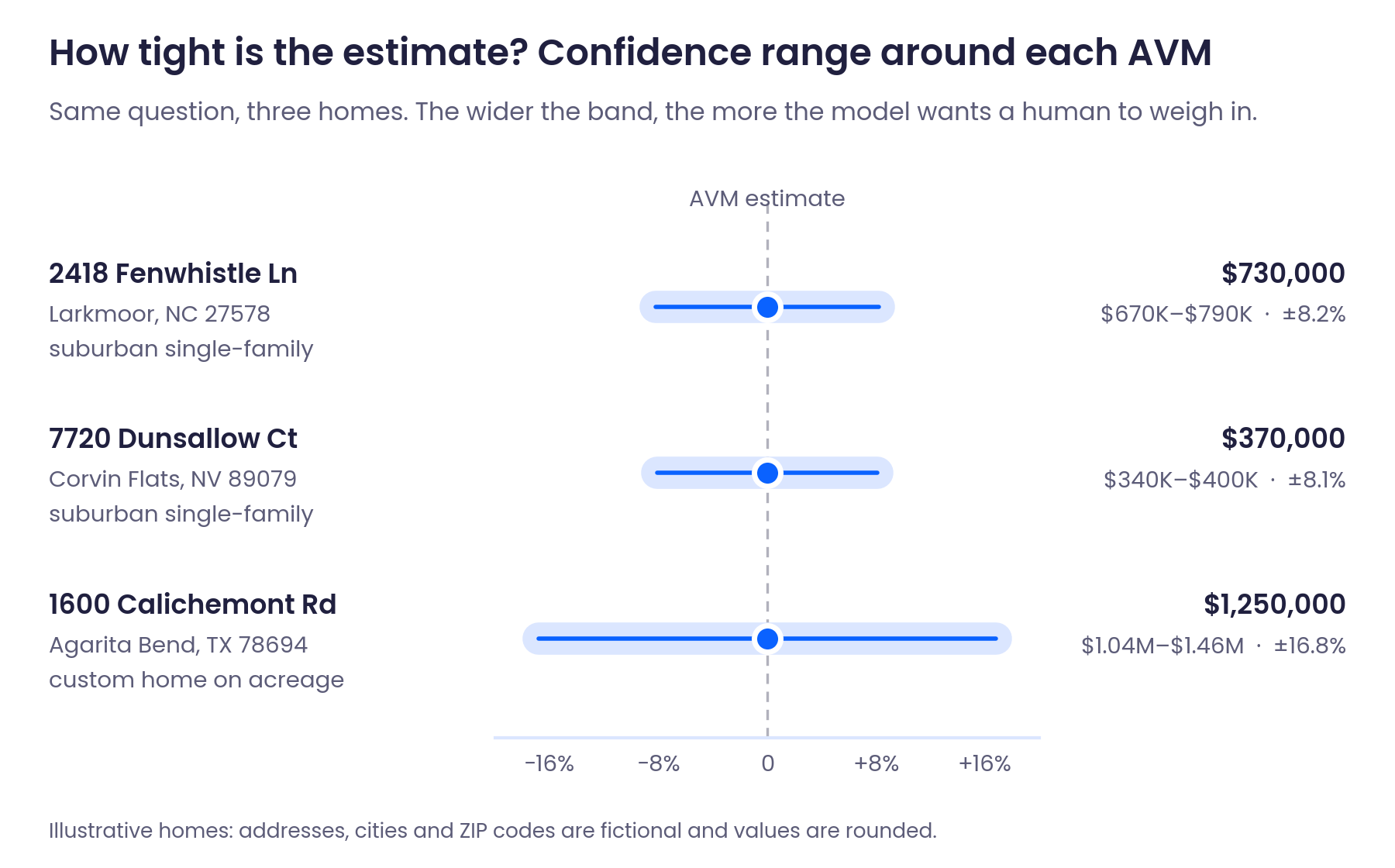
The Larkmoor home and a suburban home in Corvin Flats, Nevada, both come back tight, at ±8.2% and ±8.1%. But 1600 Calichemont Rd in Agarita Bend, Texas, a $1.25 million custom home on acreage in a ZIP where the median is $410,000, comes back at ±16.8%: a range from $1.04 million to $1.46 million. That wide band is the model being honest. There are few sales like this one, and it's telling you to bring in your own comps and judgment before you quote a seller.
That honesty matters most where public data is thin. Texas is a non-disclosure state (sale prices aren't public record), so the comps everyone else works from are sparse. HouseCanary fills that gap with its own data, and the confidence range tells you where the estimate is on solid ground and where it isn't. For scale, HouseCanary's AVM has a 2.7% median error on post-list valuations and 7.5% pre-list; the range tells you where one home sits against that. That's the difference between an automated valuation you can defend and a guess.
How does the 36-month forecast change the listing conversation?
The same question returns the 36-month forecast, not just today's value, and the three homes diverge.
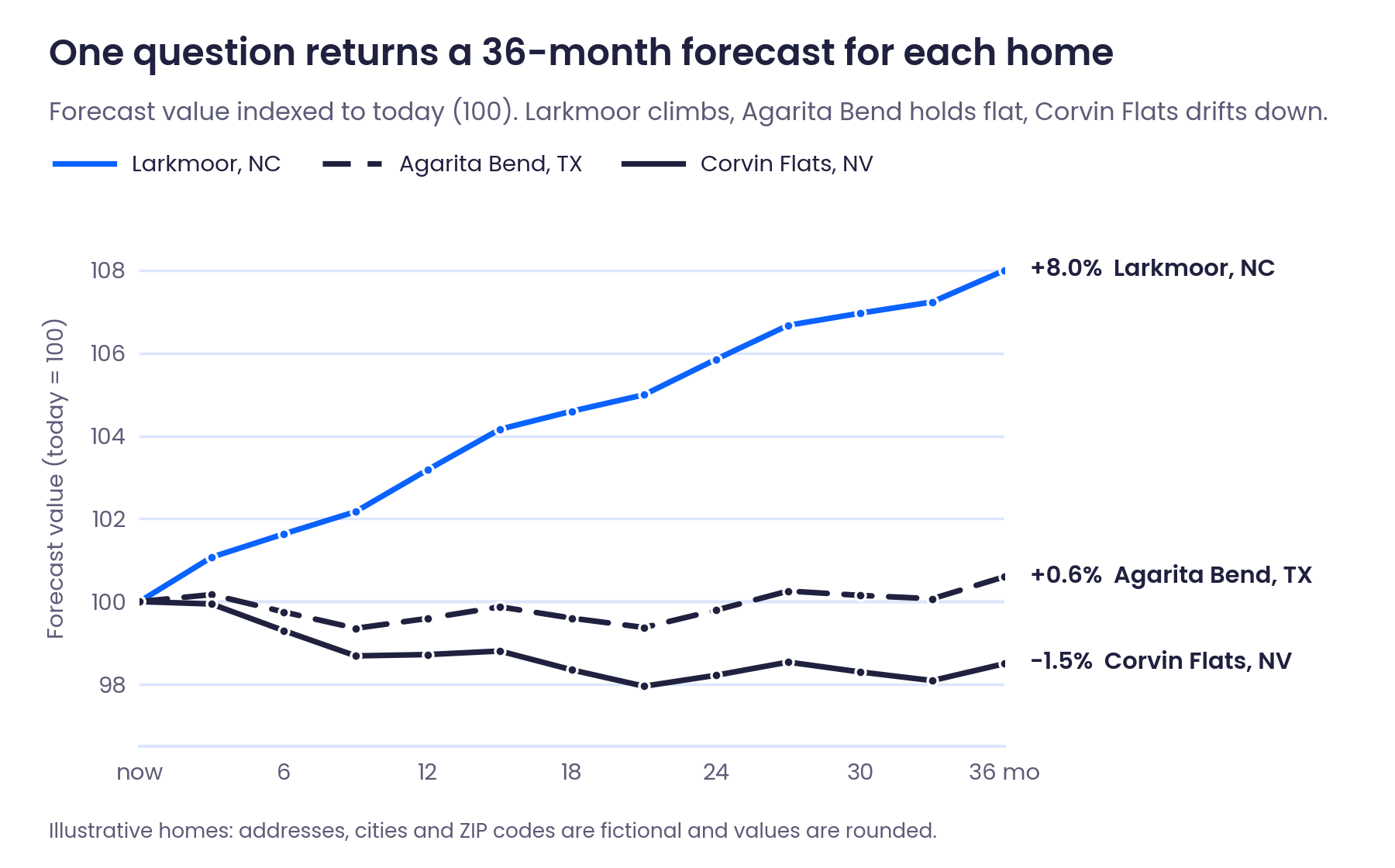
Larkmoor climbs 8.0% over three years. Agarita Bend holds roughly flat, at +0.6%. The Corvin Flats home drifts down 1.5%. That changes the conversation at the kitchen table. For the Corvin Flats seller, the data says price it to sell now rather than chase a market that isn't coming to meet you. Showing a seller that curve, sourced rather than a hunch, is often the difference between winning the listing and losing it to the agent who over-promised.
What does the answer tell an investor buyer?
When the buyer is an investor, the math is already on the table. Take the Corvin Flats home: HouseCanary values it at $370,000, with market rent of $1,775/mo, a 5.8% gross yield, inside the healthy 5–8% band.
Now say your buyer wants to offer $405,000, above the top of the $340,000–$400,000 confidence range. Run the offer through the same answer:
- Gross yield at $405,000: $21,300 in annual rent ÷ $405,000 = 5.3%
- Value in 36 months: about $364,000 on the −1.5% forecast, roughly $40,500 under the purchase price before costs
The yield still clears 5%, but the buyer would pay a premium for a home the model expects to lose value. That's a conversation worth having before anyone writes an offer.
How do you turn the answer into the CMA you send?
The MCP answer is an input to the CMA, not the CMA. It tells you what the home is worth, how sure the model is, where the market is heading, and what the home would rent for. The report you hand the seller needs more: the subject profile, three to six sold comps adjusted to the subject, the active competition, and your recommended list price with the reasoning.
That part happens in Property Explorer, which pre-selects comps, applies a time adjustment and a property adjustment to each one, and exports a client-ready PDF. Here are the subject and the first two comps from that report's comparables page for the Larkmoor home:
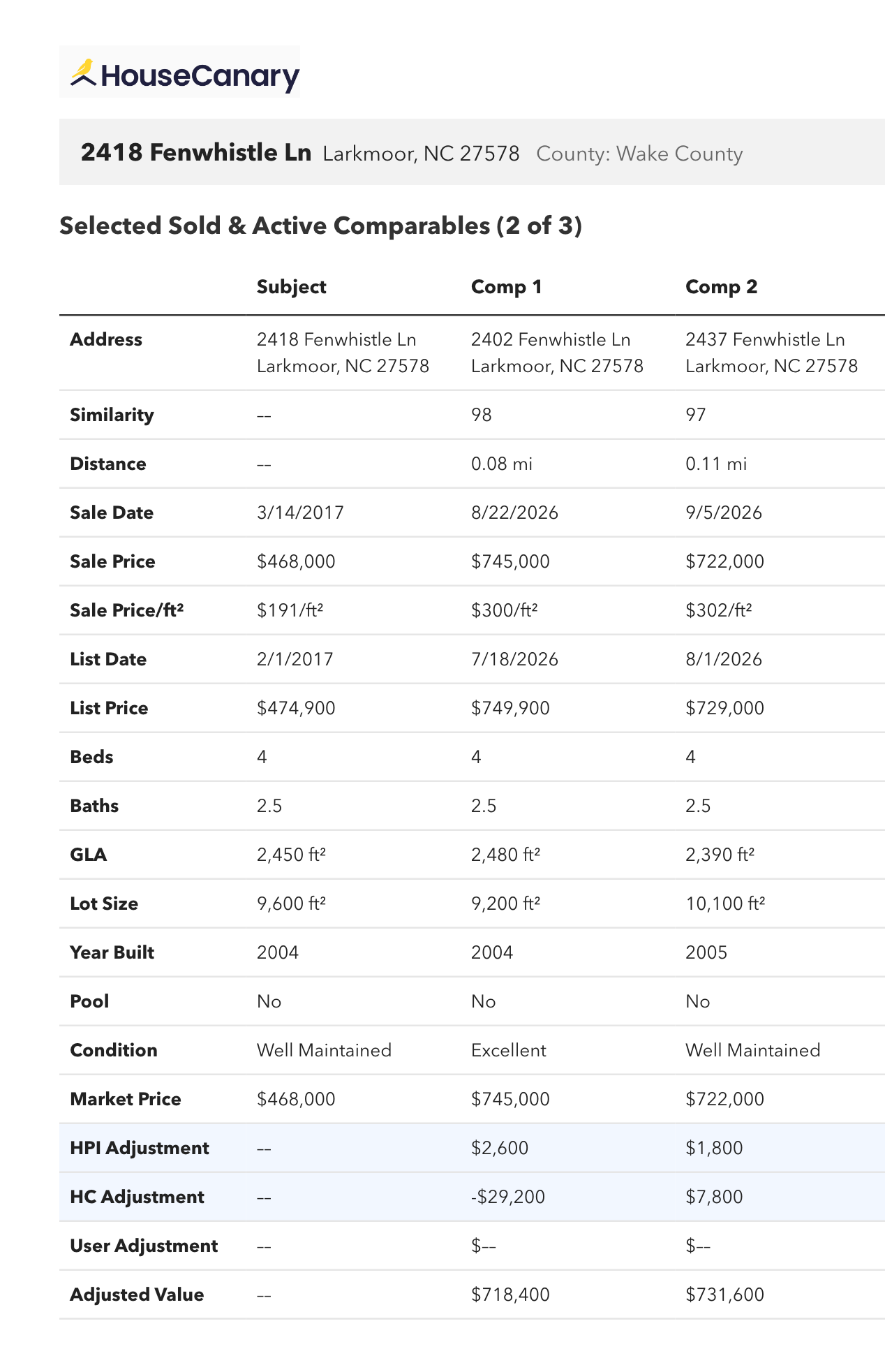
Then use the MCP answer as the check on that work. In the full report, the four comps adjust to between $702,900 and $744,200, inside the MCP's $670,000–$790,000 confidence range, so the two methods agree and you can price with conviction. If your adjusted comps land outside the range, find out why before the seller does. The step-by-step CMA guide walks through building the report on one sample home.
What can't the HouseCanary MCP do?
The limits are the point; they're what keep you in the room.
- It's a starting point, not an appraisal. The AVM anchors a pricing conversation; it doesn't sign an appraisal or carry your license.
- It isn't the CMA. The answer has no comps, no adjustments, and no recommended list price. It's the input you check that work against.
- It doesn't see inside the house. Interior condition and a recent renovation aren't in public records, so the estimate can't see them. Adjust for what you've walked through.
- It tells you when to trust your own eyes. The confidence range is the built-in cue: a wide band means pull comps and verify before you quote.
- It's read-only by design. The assistant can query values, forecasts, and market data, but it can't change or delete anything, so nothing in your workflow is at risk from a bad prompt.
- It can't read the room or negotiate. It hands you the value, the range, and the forecast; you handle the seller, the buyer, and the gap between them.
FAQ
What is the HouseCanary MCP?
A connector that lets an AI assistant such as Claude or ChatGPT pull live HouseCanary data (valuations, confidence ranges, rent, forecasts, market data) from a plain-English question, instead of estimating from training data. It's read-only and needs no code.
Do I need to know how to code to use it?
No. Connecting the MCP to your assistant is a one-time setup; after that you ask questions in plain English.
How accurate is the HouseCanary AVM?
HouseCanary's AVM has a 2.7% median error on post-list valuations and 7.5% pre-list, backed by quarterly third-party testing. HouseCanary covers 136 million properties and has generated 122M+ AVMs, and each estimate comes with its own confidence range.
What does the confidence range on a home value estimate mean?
It's the model's statement of how far off its estimate might be. A tight range, about ±8%, means price with confidence; a wide one, like ±16.8% on the custom home above, means treat the number as a starting point and verify with comps. HouseCanary reports it as the forecast standard deviation (FSD).
Can ChatGPT or Claude use HouseCanary data for me?
Yes. The HouseCanary MCP server connects assistants like Claude and ChatGPT directly to HouseCanary's valuation and market data.
How much does it cost?
HouseCanary agent plans start at $190 a year and include property valuations, CanaryAI, and Market Insights; Pro, at $790 a year, adds unlimited CMA reports and two team seats. The MCP itself connects with HouseCanary API credentials and bills tool calls as API usage; the MCP server guide covers setup and billing.
Put it to work on your next listing
The fastest way to feel the difference is on a property you already know: ask for its value and read the confidence range against the price you had in mind. HouseCanary for real estate agents includes the valuation, confidence range, and forecast data behind this post. HouseCanary agent plans start at $190 a year, and Pro, at $790 a year, adds unlimited CMA reports; see agent pricing.