


Table of Contents

HouseCanary
Know what any property is really worth.
AVMs with a 2.7% median error, plus the comps and forecasts agents and investors rely on.
Explore PlansAn AI agent is software that takes a goal and completes the steps to reach it — not software that waits for you to click through menus. For real estate agents, that difference is starting to matter: the tasks that eat your week (building CMAs, chasing follow-ups, figuring out who in your farm might sell) are exactly the kind of multi-step work agents automate. Here's what AI agents can actually do for your business in 2026, what data they need to do it well, and where they still fall short — including a real session of an AI assistant answering a listing question with live HouseCanary data.
Data and accuracy claims in this post reviewed by Chris Stroud, Chief Research Officer at HouseCanary.
Key Takeaways
- An AI agent completes multi-step tasks on its own; a chatbot answers questions and a tool displays data. The distinction determines what you can hand off.
- The highest-value agent use cases today: valuation and CMA work on demand, ranking likely sellers before they list, and prioritizing follow-up.
- AI agents are only as good as the property data behind them. Accuracy compounds — a valuation model with a 2.7% median error produces very different recommendations than one guessing from stale comps.
- What AI agents can't do: read a room, negotiate, or take fiduciary responsibility. The agents who win with AI hand it the busywork and keep the judgment.
What Is an AI Agent in Real Estate?
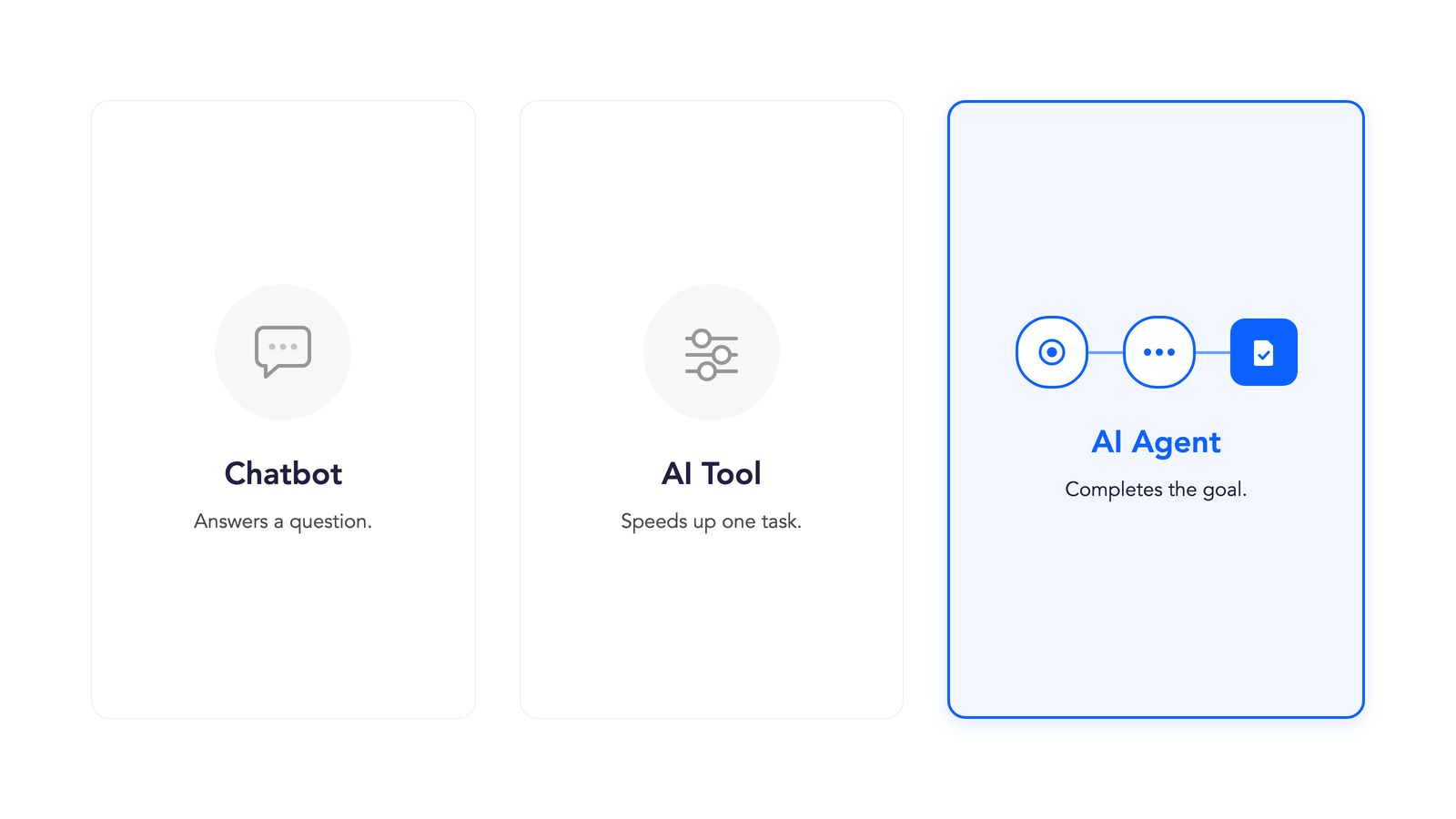
An AI agent is software that pursues a goal across multiple steps without you directing each one. You give it an outcome — "value this property and show me how you got there" — and it retrieves the data, runs the analysis, and returns a finished result. This matches how AI labs themselves draw the line: Anthropic's "Building Effective Agents" defines agents as systems that "dynamically direct their own processes and tool usage" — versus workflows that follow predefined paths. That's the difference between an agent and the AI features you've already seen:
Most of what's marketed as "AI for realtors" is the first two — we covered the tool landscape in our AI tools for real estate agents roundup. NAR's 2025 Technology Survey bears this out: 68% of Realtors now use AI, but only 17% say it's made a significant difference — the gap between having a chatbot and delegating real work. Agents are the newer layer, and they change the question from "which app do I open?" to "what do I delegate?"
Use Case 1: CMAs and Valuations on Demand
You're at a kitchen table and the seller thinks their home is worth $50K more than it is. The old move: promise a full CMA tomorrow and hope the moment doesn't pass. The agent move: ask, in plain English, for the value, the comps, and the trend — and walk through the answer on the spot.
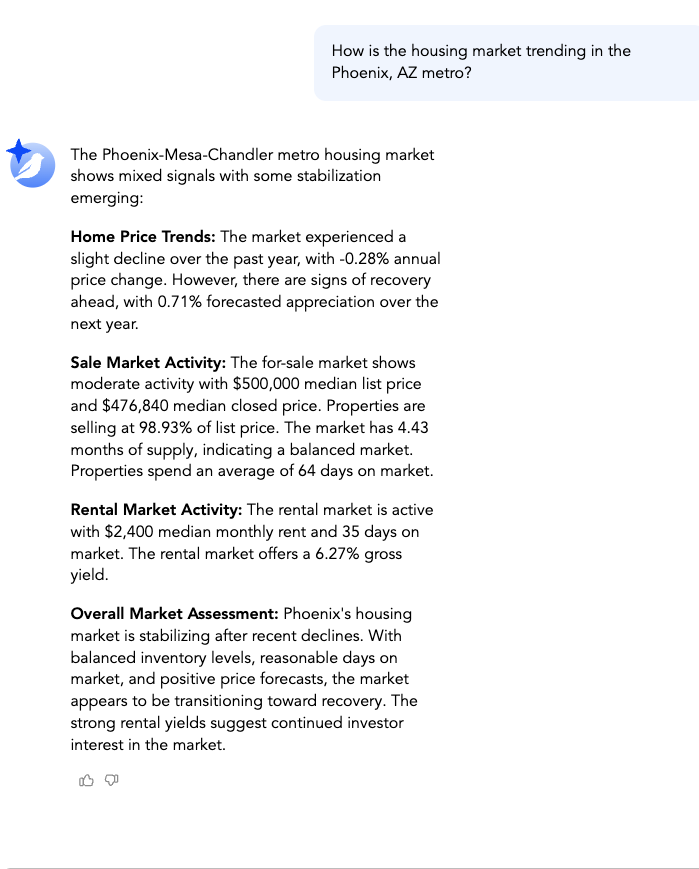
Inside HouseCanary, that plays out in two layers. CanaryAI takes the plain-English questions — "how is the Phoenix metro trending?" — and answers with live market data you can read straight off the screen.
The CMA work product itself lives in Property Explorer: the estimate, the valuation range, the comps, and the line-item adjustments — square footage, lot size, bath count — in a client-ready interactive report, drawn from 136 million properties nationwide. It's the same valuation engine that has generated over 122 million AVMs, with a 2.7% median error on post-list valuations (7.5% pre-list). The number you show a seller holds up because the model behind it does.
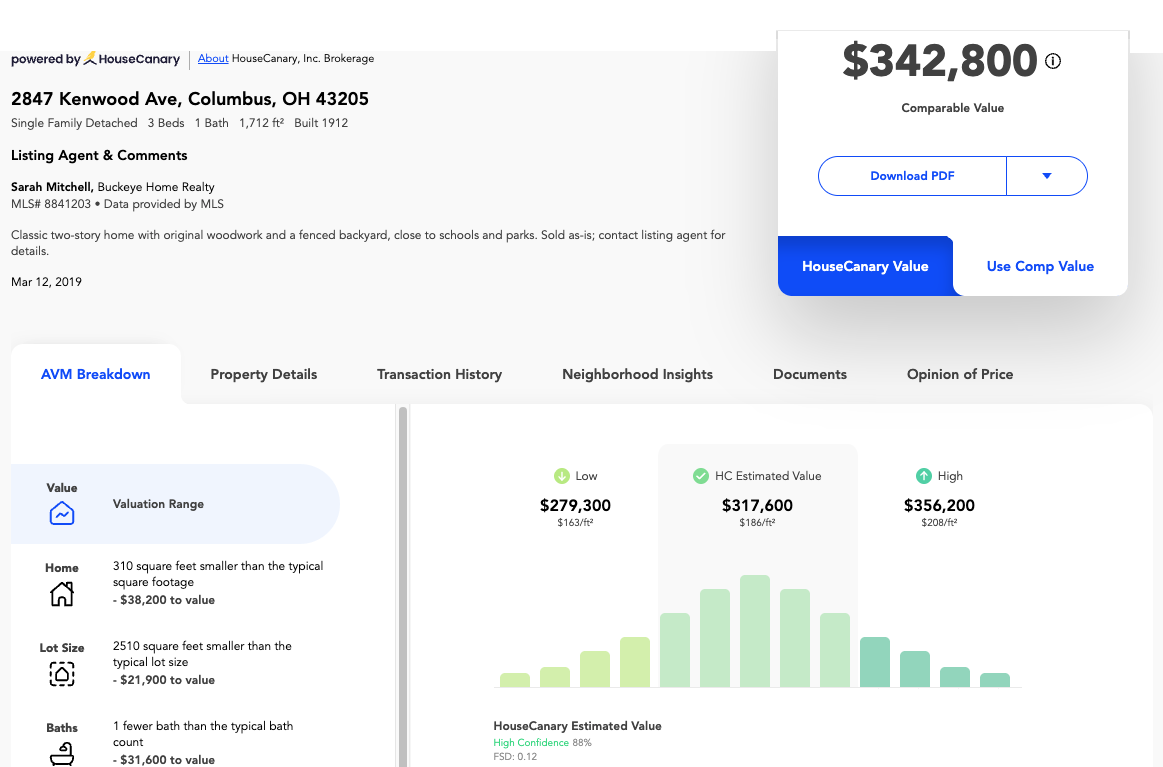
What 2.7% means at the kitchen table: on a $450,000 listing, the median post-list miss is about $12,000 — tight enough to anchor a pricing conversation. A model missing by 7-8% is off by $34,000 on the same house, which isn't a starting point; it's an argument. Accuracy isn't a spec-sheet number — it's whether the seller believes you.
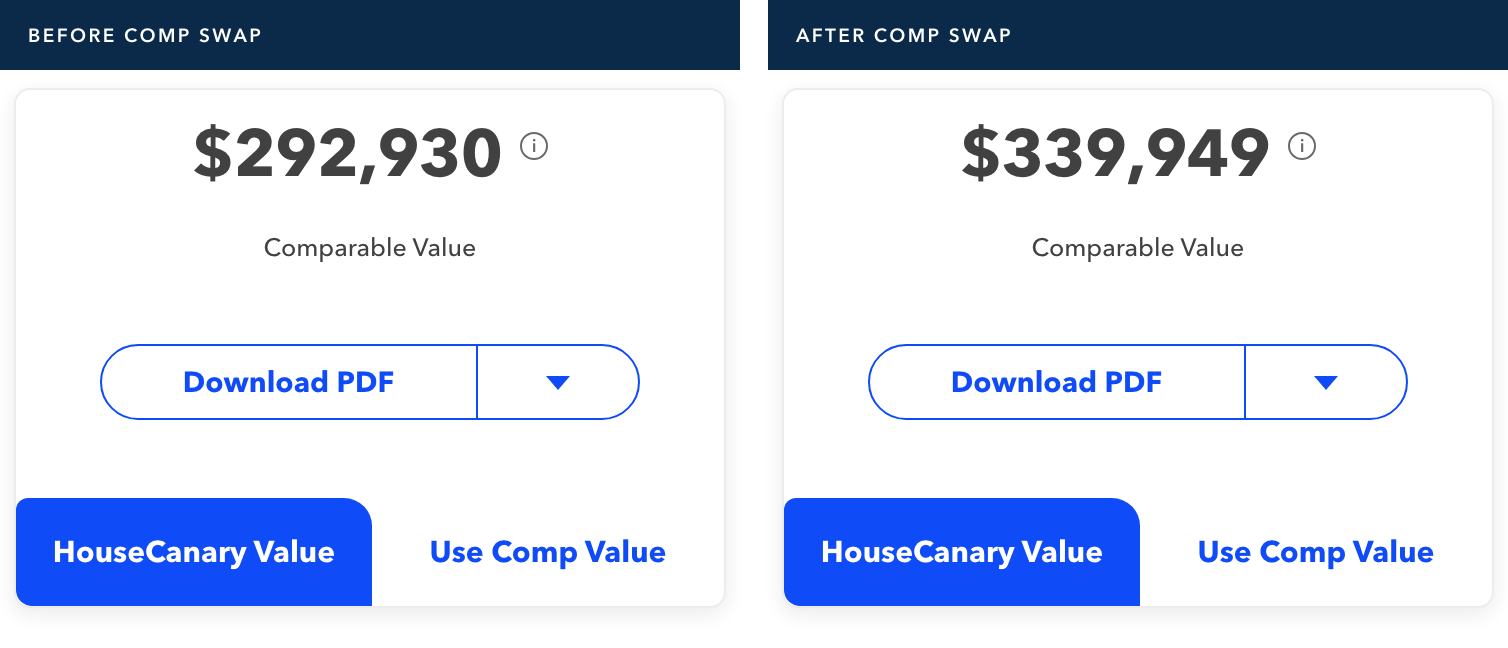
And it iterates the way you do. Swap out a comp that doesn't fit and the comparable value recalculates on the spot — in the capture below, one comp swap moved the comparable value from $292,930 to $339,949. That $47,000 difference is the comp-selection conversation every agent has had; here it takes a click to show instead of an hour to rebuild.
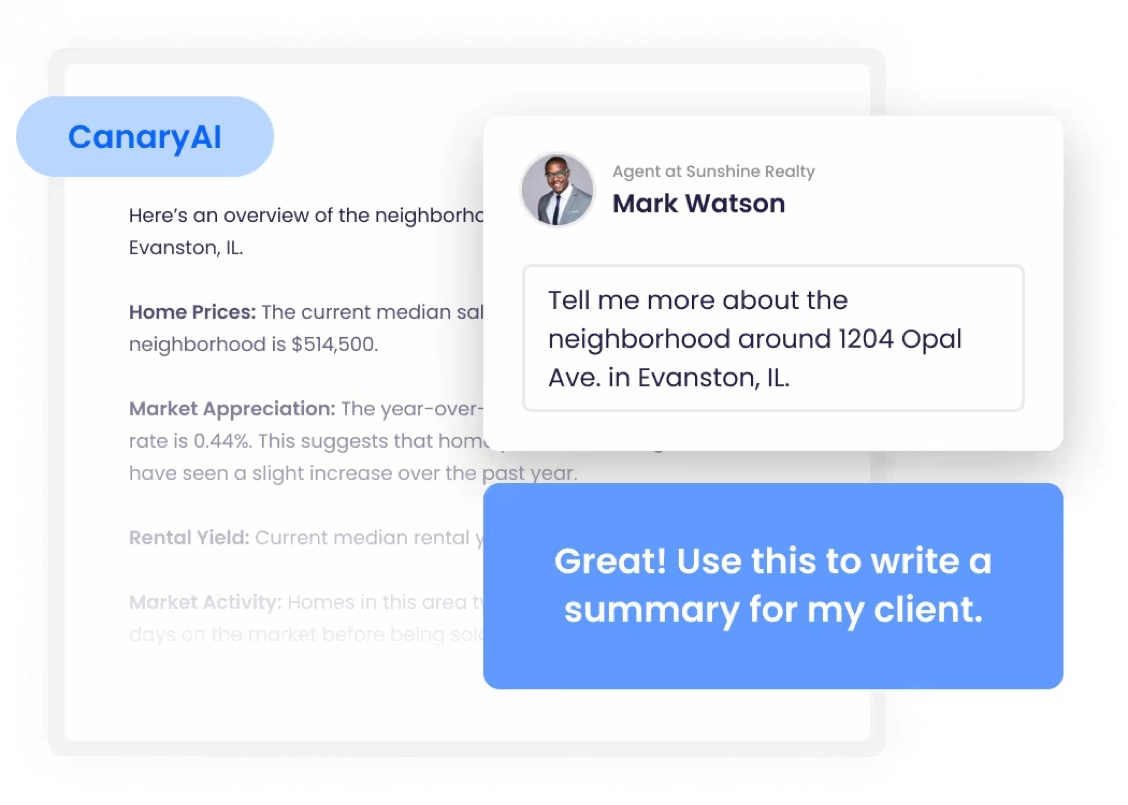
The last step is the one clients actually see: hand the analysis to CanaryAI and ask for a client-ready summary.
If you're newer to CMA workflows, start with how to use a CMA tool.
Use Case 2: Finding Likely Sellers Before They List
Every farm has homeowners who will list in the next 90 days. The question is whether you find out before or after the sign goes up.
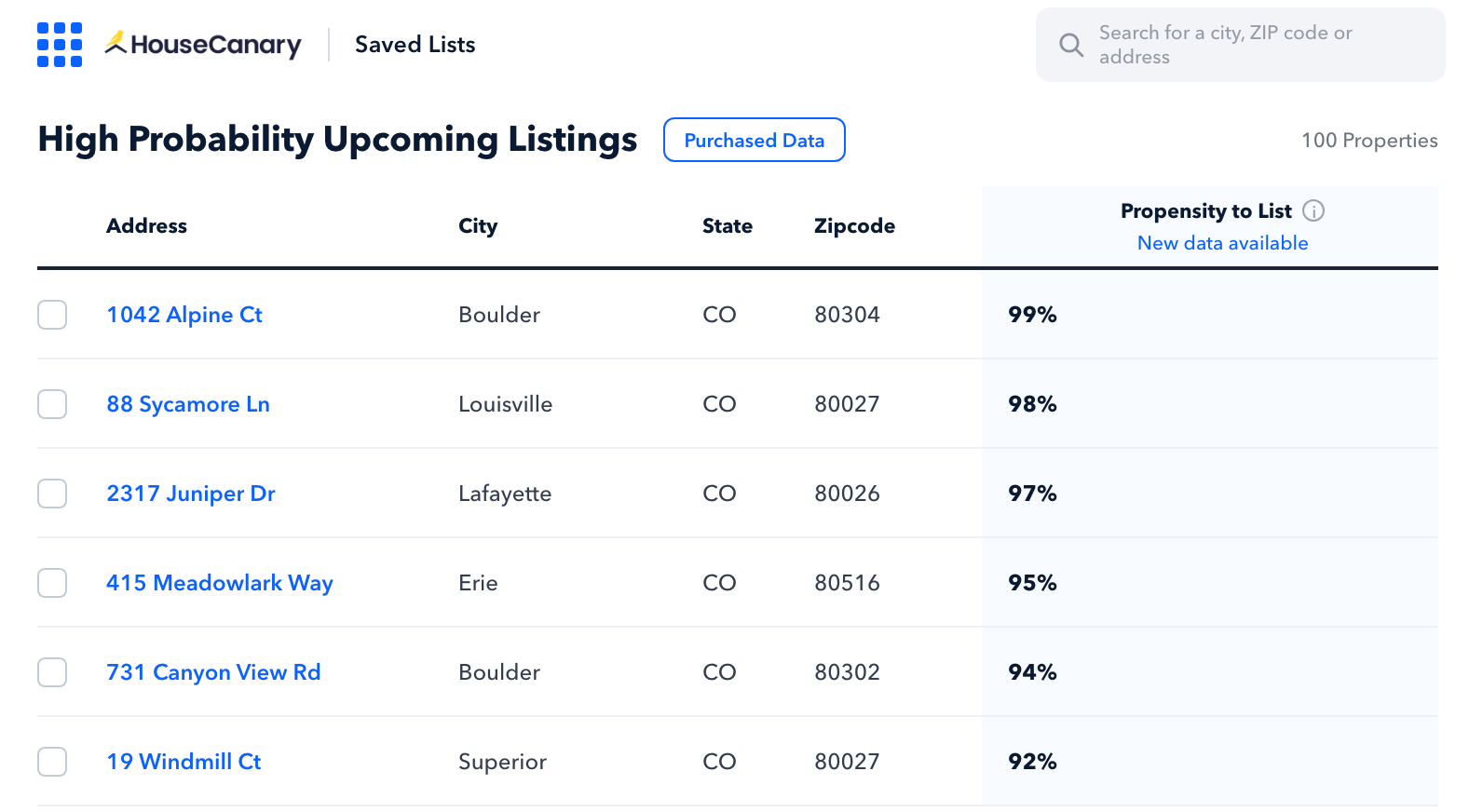
Strictly speaking, this one is the prediction layer rather than an agent itself: HouseCanary's propensity-to-list scoring is a predictive model that ranks properties by their probability of listing in the next 90 days, expressed as percentiles against the whole market. The agent work happens on top of those scores — point an AI agent at your farm and a one-time export becomes a maintained call list, re-ranked as scores move and trimmed as homes hit the MLS — not a spreadsheet of everyone you've ever met. We've written about the mechanics in spotting off-market leads with predictive data.
Use Case 3: Prioritized Follow-Up and Nurture
Follow-up is where deals are won and where AI promises the most and delivers the most unevenly. Drafting the check-in email is the easy part — most CRMs do that now. The hard part is knowing who deserves the call today.
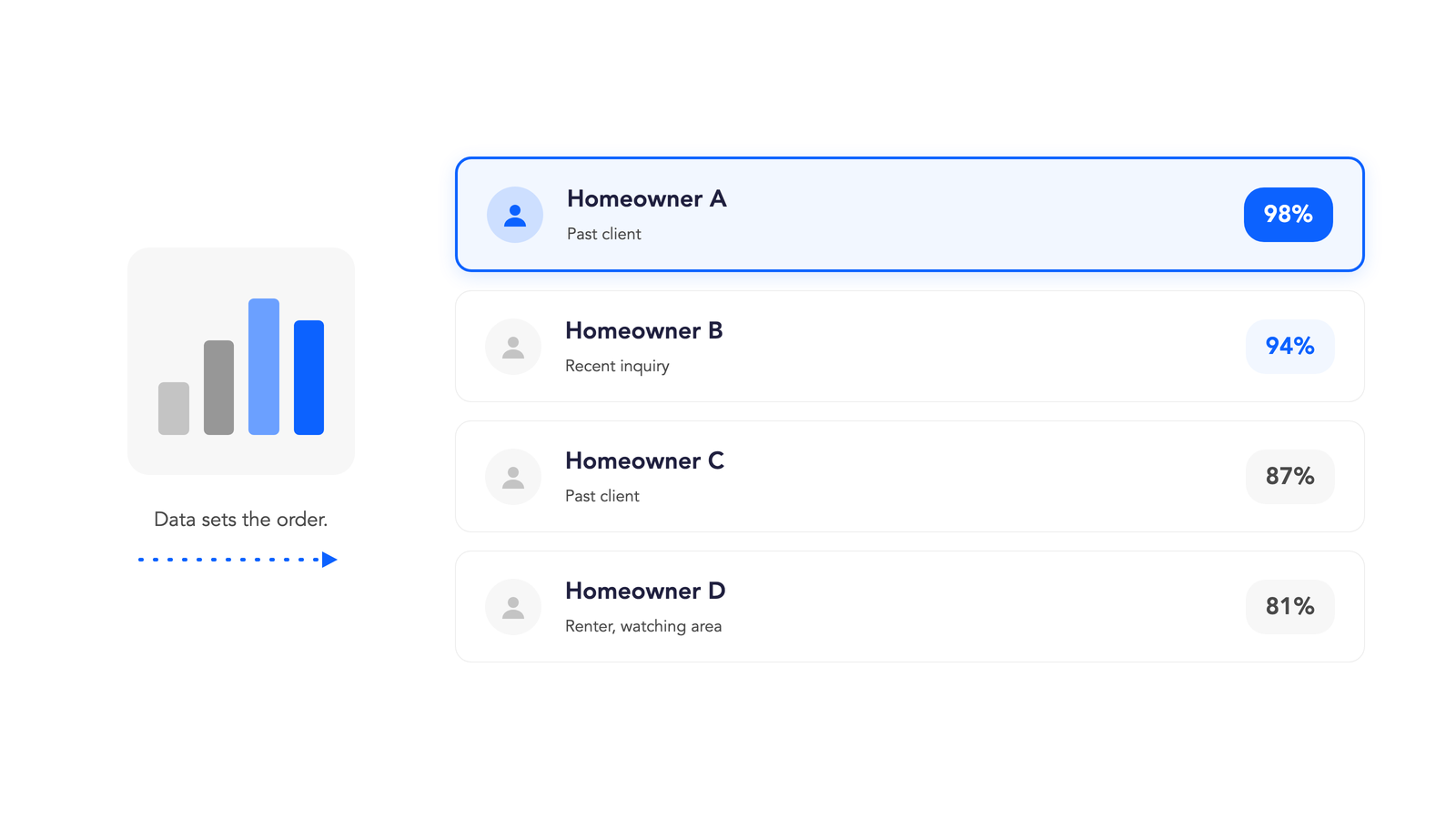
That's a data problem, not a writing problem. Pair whatever nurture automation you already run with listing-likelihood signals, and the follow-up sequence stops being a calendar rotation and starts being a ranked queue: past clients whose equity and tenure suggest a move, farm contacts whose scores just jumped. Your CRM's AI writes the message; the data decides the order. (For the broader pipeline picture, see lead generation for realtors.)
Use Case 4: Showing Coordination and Virtual Showings
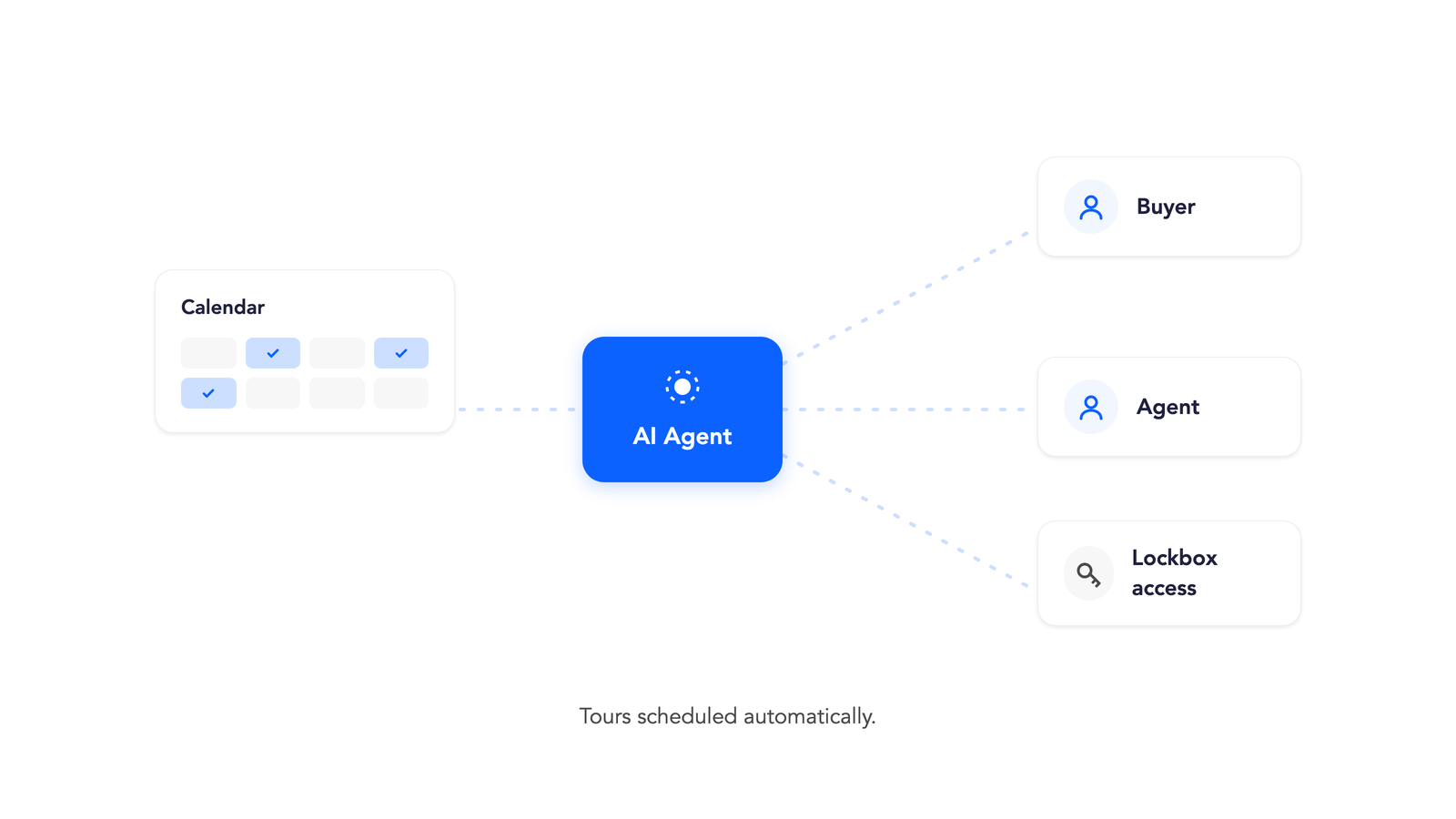
Scheduling is pure logistics — timezone math, lockbox windows, buyer availability — which makes it natural agent territory. The current generation of scheduling agents handles the back-and-forth of tour coordination, and virtual-showing platforms are starting to match buyers to properties based on stated criteria rather than saved searches.
This category is earlier than the valuation and prediction use cases. The honest summary: coordination agents save real hours today; buyer-matching is promising but young. Treat vendor claims here the way you'd treat an online estimate at a listing appointment — a starting point to verify, not a number to repeat.
Use Case 5: Training and Education
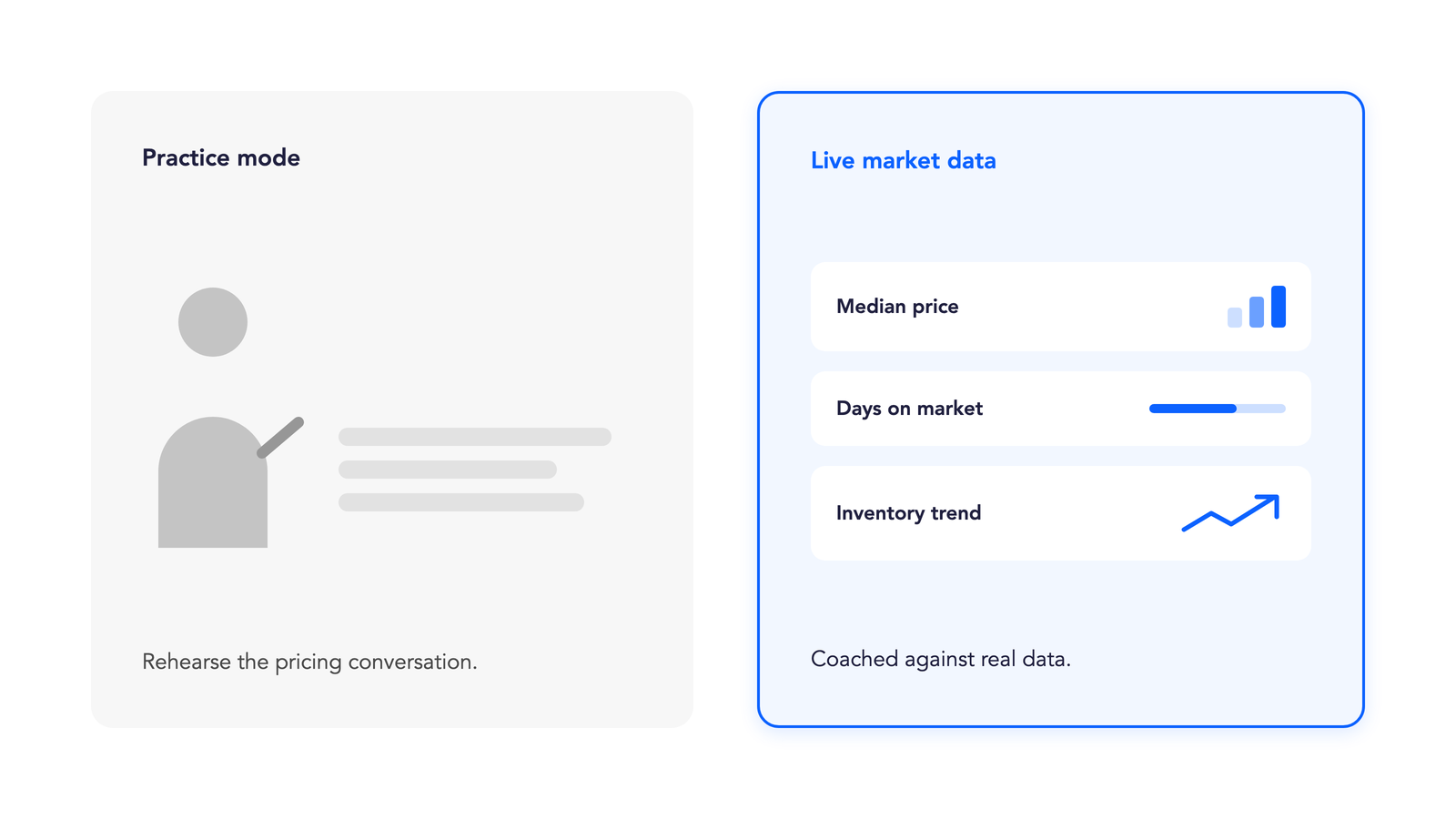
New agents traditionally learn markets by osmosis — years of showings, open houses, and missed pricing calls. AI compresses that: role-play a listing presentation against an AI that pushes back on your price, drill objection handling, or quiz yourself on a ZIP code's actual months of supply before a buyer consult. The difference between generic practice and useful practice is whether the AI is working from real market data or improvising. Practicing a pricing conversation against real numbers — current inventory, actual price-cut share, the true median — builds instincts that transfer to the kitchen table.
Bring Your Own AI Agent: HouseCanary via MCP
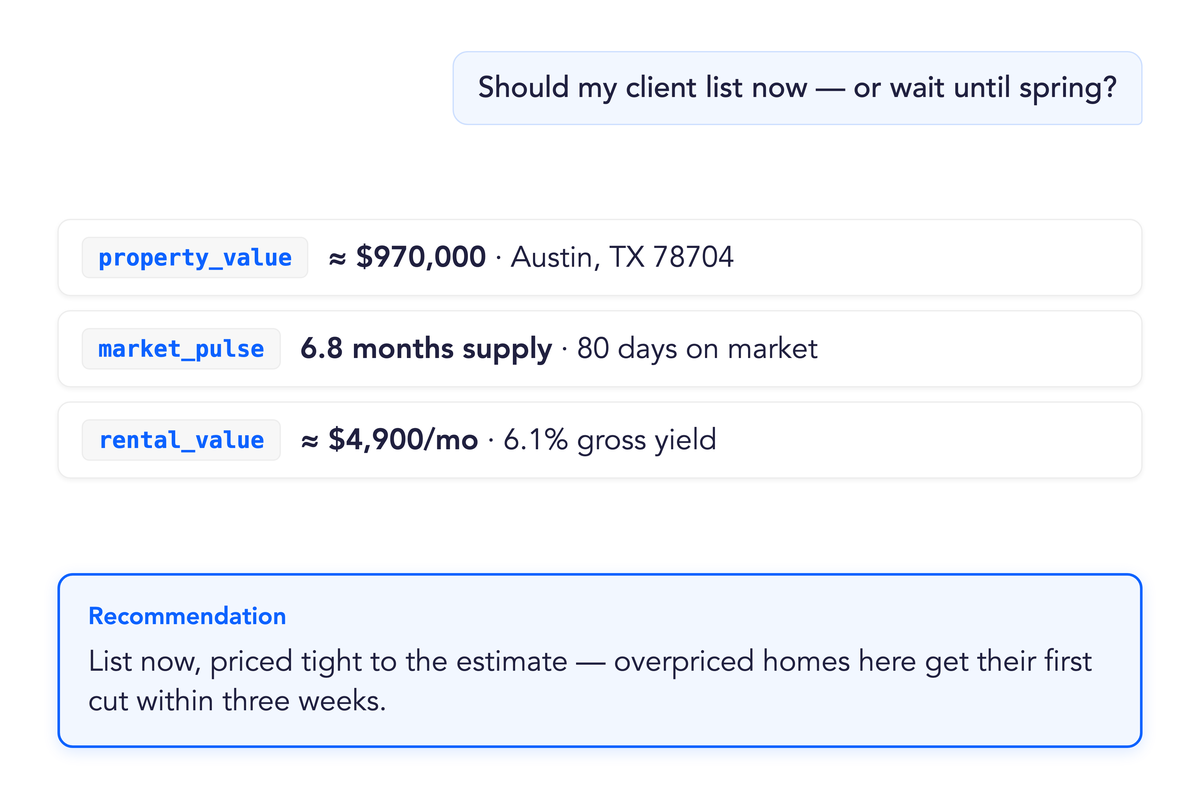
Everything above runs inside HouseCanary. But if your workflow already lives in an AI assistant — Claude, ChatGPT, or any agent that speaks the Model Context Protocol — HouseCanary's data can come to you. The HouseCanary MCP server connects your assistant directly to the same valuation engine behind every number in this post: ask for a value, a rent estimate, or a market read, and the agent calls HouseCanary's tools and synthesizes the answer.
Here's what that looks like in practice. We connected an assistant to HouseCanary and asked one question: "Should my client list their South Austin home now or wait until spring?" The assistant planned the work itself — it called the property-value tool, pulled the ZIP's market pulse, and checked the rental value, then turned three lookups into a recommendation an agent could act on. The capture below is that session.
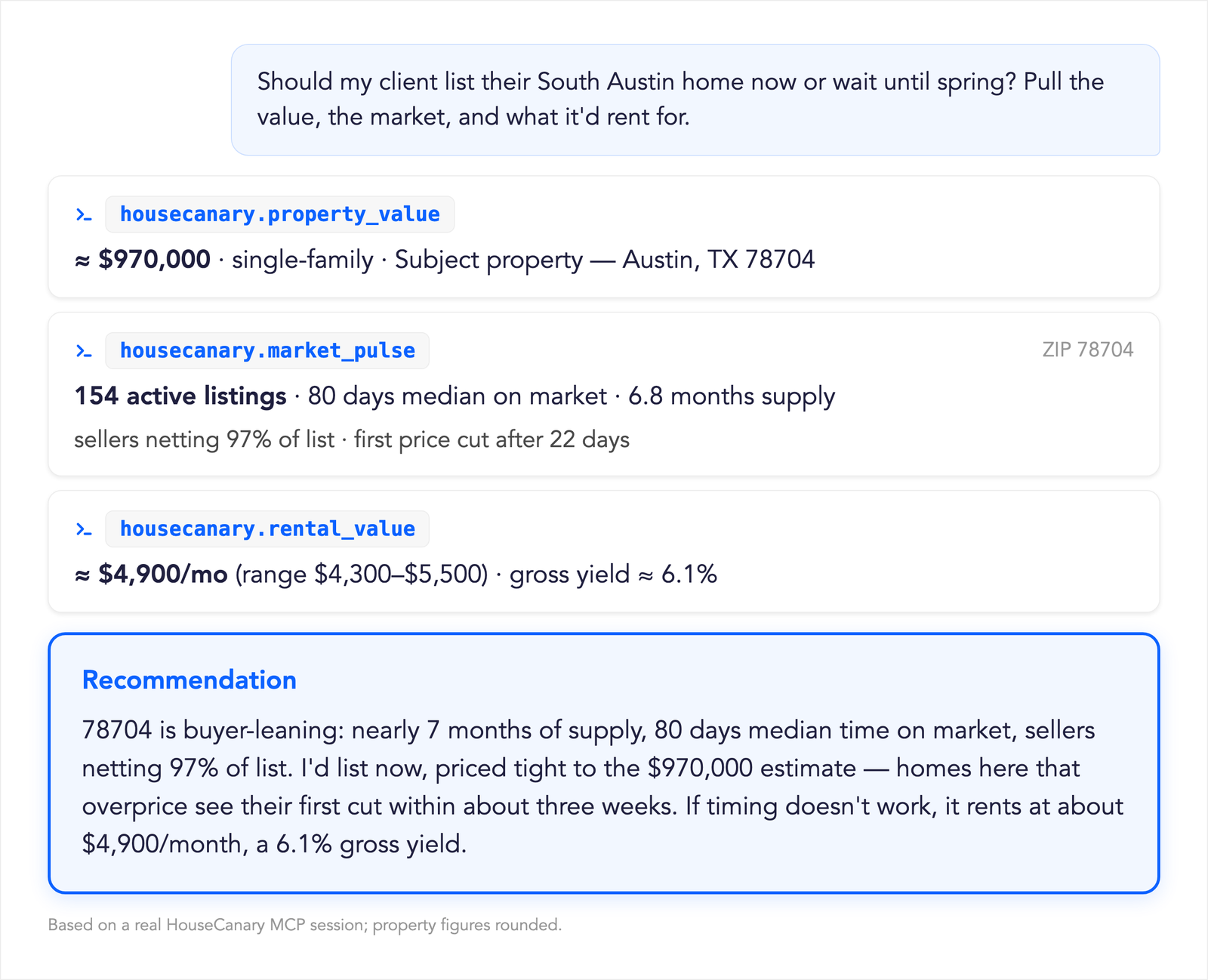
The reason this matters is grounding. Ask a general-purpose assistant what a home is worth and it will estimate from training data — confidently, and often wrong. Connected to HouseCanary, it stops guessing: the value comes from the same AVM with a 2.7% post-list median error, and the market read comes from listing data updated weekly. And the ceiling on "what can I ask?" is high — the MCP server exposes 150+ read-only data tools, spanning valuations, rental estimates, market pulse by ZIP, home-price-index forecasts, sales and tax history, natural-hazard risk, and school and neighborhood data.
This is the purest version of the agent thesis: your assistant plans the steps; HouseCanary supplies the ground truth it reasons over. Setup requires a HouseCanary account; the MCP server guide walks through connecting Claude, ChatGPT, or any MCP-compatible assistant.
What AI Agents Can't Do Yet
The limits are as important as the capabilities — they're what make you not replaceable.
- Read the room. An agent can rank your call list; it can't hear the hesitation in a seller's voice or know that a couple is divorcing and the price conversation is really about speed.
- Negotiate. Multi-step task completion is not multi-party persuasion. No AI agent closes a gap between an anchored seller and a stretched buyer.
- Take responsibility. You hold the license and the fiduciary duty. An AI agent's output is your input, never your signature.
- Outrun bad data. Every use case above degrades with weak inputs. In non-disclosure states, where sale prices aren't public record, models without proprietary data coverage are guessing — and an autonomous workflow built on guesses just makes wrong calls faster.
FAQ
What is an AI agent in real estate?
Software that completes multi-step real estate tasks autonomously — like producing a CMA with comps from one request, or ranking a farm by listing likelihood — rather than answering one question at a time.
Are AI agents replacing real estate agents?
No. They absorb the analysis and logistics (valuations, prioritization, scheduling) while the licensed agent keeps the relationship, negotiation, and fiduciary judgment. The realistic risk isn't replacement; it's competing against an agent who delegates busywork while you do it by hand.
What's the difference between an AI agent and a chatbot?
A chatbot answers questions. An AI agent takes a goal and executes the steps — retrieving data, running analysis, producing a finished output. See the comparison table above.
What data do AI agents need to work well?
Accurate valuations, current comps, and predictive signals like listing propensity. Output quality tracks input quality directly — which is why the valuation engine underneath matters more than the chat interface on top.
What's the best AI agent for a real estate team?
Judge any AI agent on three things: the data underneath it (valuation accuracy you can state as a number, coverage in your specific markets — including non-disclosure states), whether it completes tasks or just answers questions, and whether its output is verifiable enough to put in front of a client. Feature lists age fast; those three don't.
Can my AI assistant use HouseCanary for me?
Yes. AI assistants with browsing can already read HouseCanary's plans, market reports, and product pages to answer questions on your behalf — try asking one to compare HouseCanary's agent plans. For direct data access, HouseCanary also offers an MCP server that connects assistants like Claude and ChatGPT to its valuation and market data.
Put an AI Agent to Work on Your Next Listing
The fastest way to see the difference is on a property you already know: ask CanaryAI to value your current listing and compare its comps to the ones you picked. HouseCanary for agents includes CanaryAI, unlimited CMAs, and the propensity data behind every use case in this post — plans at agent pricing.