

Table of Contents

HouseCanary
Know what any property is really worth.
AVMs with a 2.7% median error, plus the comps and forecasts agents and investors rely on.
Explore PlansOverview
The seller has a number in their head before you sit down. It came from a website, a neighbor's sale, or what they paid plus what they think they've earned since. Your job is to replace it with a better one and show the work, and a comparative market analysis is how you do it. This guide covers how to do a comparative market analysis in the four steps every CMA shares, then goes where most guides stop: the adjustment math in dollars on one sample home, how many comps is enough, and what to do when the adjusted comps still disagree. It ends with what a CMA cannot tell you, because the seller will ask.
Key Takeaways
- A CMA answers one question: what will this home sell for in the next 30 to 60 days. It is an opinion of price, not an appraisal and not an automated estimate.
- Most agents keep 3 to 6 sold comps selected, closed within 90 days, within about half a mile, within 20% of the subject's living area, same property type and story count, chosen from a wider set the software pre-selects; Property Explorer starts you at eight.
- Adjust each comp toward the subject in dollars, feature by feature, using rates from paired sales in that market. On the sample home below, four raw sales spanning $498,000 to $572,000 adjust to $464,500 to $514,600.
- When adjusted comps still disagree by more than about 5%, the spread is information. Widen the set, check pending sales and expired listings, and read a valuation that reports its own confidence range.
- In most cases the HouseCanary CMA can go to the seller as is: the comps, the time and property adjustments, and the range are already done. The agent's work is choosing which number goes on the report and explaining why.
What is a CMA, and what question does it have to answer?
A comparative market analysis (CMA) is the process an agent uses to estimate what a home will sell for by finding recently sold homes that compare to it, adjusting each sale price for the differences, and reading a list price out of the adjusted range.
The question it answers is narrower than "what is this home worth." A CMA answers "what will this home sell for in the next 30 to 60 days, against the homes it will compete with." That framing decides which sales count as comparable, how far back you look, and how much weight a pending gets against a closed sale. An appraisal answers a lender's question about collateral; a CMA answers the seller's question about a list price. For the longer definition and the software agents use, see the comparative market analysis tool guide.
The four steps are the same in every CMA. What separates a CMA the seller trusts from one they argue with is how you do steps two and three.
Step 1: How do you profile the subject property?
Start by getting the house right. Pull the public record and the last listing, then walk through the home yourself. The checklist most agents work from:
- Type and structure: property type, stories, year built, garage type and spaces, basement, pool.
- Size: gross living area, above and below grade if the record splits them, lot size.
- Rooms: bedrooms and bathrooms as they are today, not as they were last listed.
- Condition: one honest word for the whole house, then the exceptions. Roof, HVAC, kitchen, and baths carry most of the adjustment weight later.
- Location negatives: backing to a road, a flood zone, a power line, a school parking lot. Buyers price these; comps that don't share them need an adjustment.
Two inputs most CMAs skip. First, what the seller has done since they bought: permits, a remodel, a new roof. Ask for receipts and dates; that is where the seller's number usually comes from. Second, what the listing photos won't show: deferred maintenance, a floor plan that fights the market, an unpermitted addition. You cannot adjust for what you have not seen.
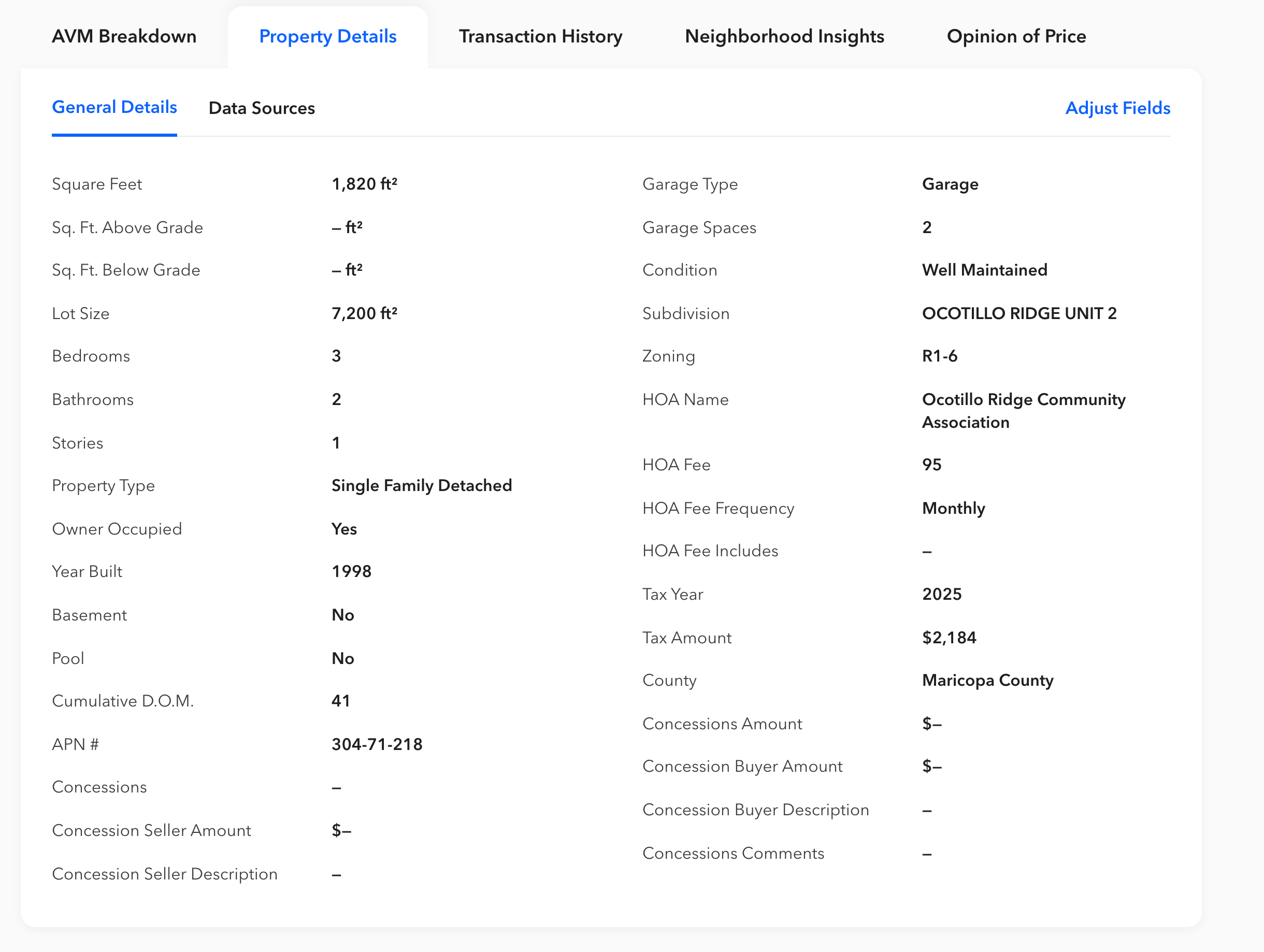
Here is the profile for the sample home this post prices throughout, a single-family detached home in a suburban Phoenix-area tract subdivision: 3 bedrooms, 2 baths, 1,820 square feet, a 7,200 square foot lot, built 1998, one story, 2-car garage, no pool, condition recorded as Well Maintained. The home, its comps, and the figures in the screenshots are illustrative, built from typical numbers for that kind of subdivision, so no real seller's data appears in this post.
Step 2: How do you pick comps that actually compare?
Pick fewer, closer comps rather than more, looser ones. How close is close depends on where you are. In a dense tract subdivision, half a mile can hold forty sales a year and you can afford to be strict; in a rural or luxury segment the same radius holds three, and you widen by distance, time, or both and say so. Valuation software handles that trade-off with a similarity score rather than a fixed radius, which is why the closest comp by distance is not always the top-ranked one. The thresholds most agents use:
Sold comps set the value. Property Explorer's default set also includes active listings, adjusted from their list price, and they count toward the Comparable Value as long as they stay selected. A list price is an ask, not a sale, so decide deliberately: keep an active selected when it is the home your seller will be compared against this weekend, and deselect it when it is a hopeful number nobody has paid yet. Pending sales tell you what buyers accepted this month and belong in the presentation either way.
When you have to widen the set, say so and say why. "Only two homes in the subdivision closed this quarter, so I added two from the neighboring subdivision by the same builder" is a sentence a seller can trust. A silent 1.5-mile radius is not.
Rental comps follow the same logic with different thresholds; if the seller is weighing leasing instead, the rental CMA guide covers that separately.
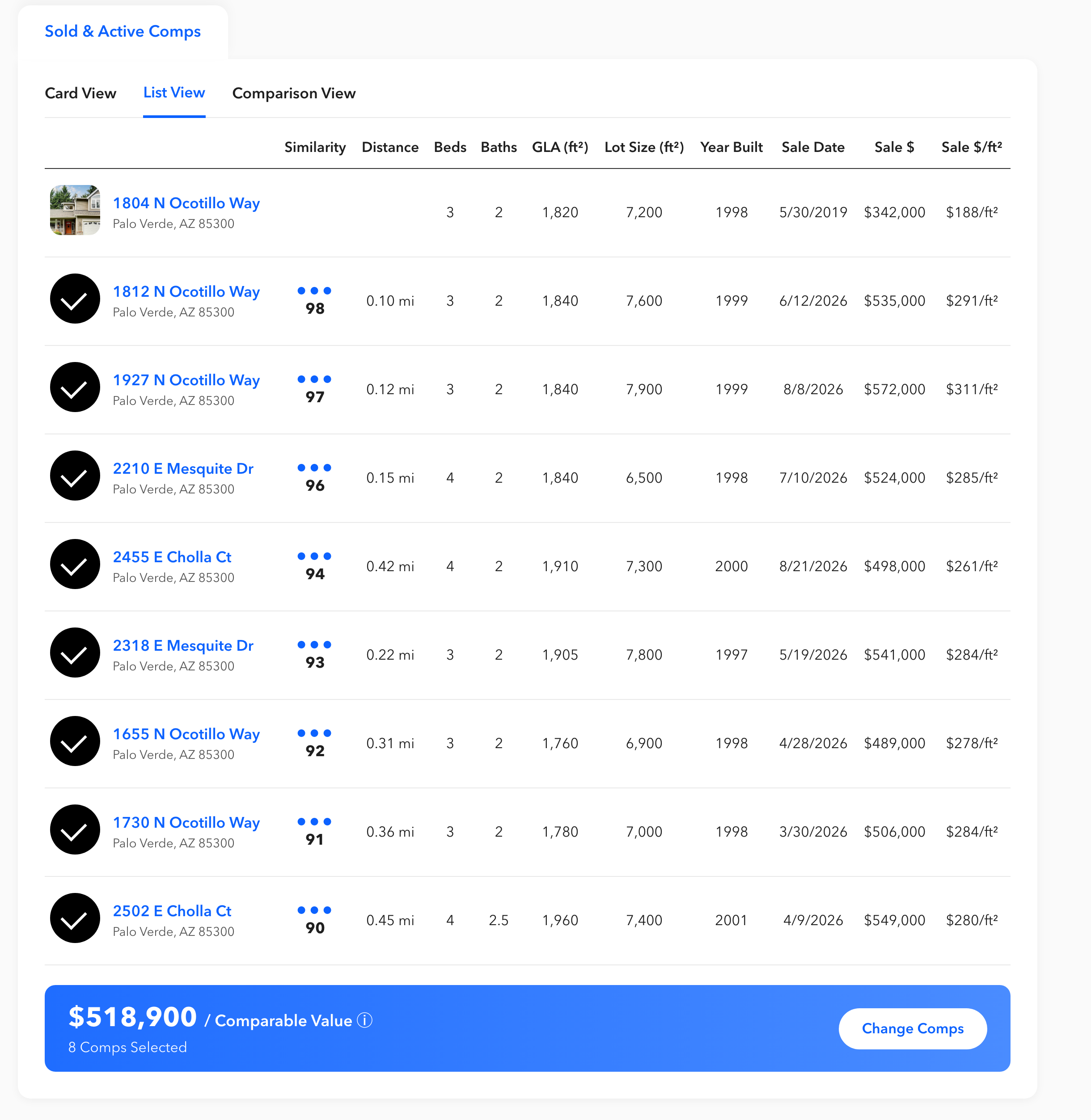
For the sample home, Property Explorer selected eight closed sales, all in the same ZIP, all single-family detached, all within 0.45 miles, with a similarity score from 90 to 98. The four with the highest similarity scores are adjusted in the next step.
Step 3: How do you adjust comps, in dollars?
Adjust the comp toward the subject, never the other way. If the comp has a pool and the subject does not, subtract the pool's value from the comp's sale price. If the comp is smaller, add. Every line in the grid answers one question: what would this comp have sold for if it were the subject?
You will rarely do this by hand. Property Explorer computes a time-of-sale adjustment and a property adjustment for every comp and shows the adjusted value beside the sale price, so the CMA arrives with the arithmetic done. The grid below is what that arithmetic looks like when you open it up, so you can defend the number at the kitchen table.
The rates come from paired sales in that market, not from a national rule of thumb. A pool is worth one number in Phoenix in September and a different number in Minneapolis, and the way you find yours is by comparing sales that differ in one feature and little else. The rates below are an illustrative grid for this market and this price band; treat them as the shape of the work, not a lookup table.
Read the table the way a seller will. Comp 2 sold for $572,000, and that is the number the seller has heard. It was also a full remodel with a pool. Adjusted to the subject it indicates $514,600, and the seller can see exactly why in two lines. Comp 4 sold cheapest and adjusts lowest, and it is also the farthest away and the largest, which is why it gets less weight in the next step.
Four raw sales that spanned $498,000 to $572,000 now indicate $464,500 to $514,600, with three of the four between $501,600 and $514,600.
Two rules keep the grid honest. Keep the net adjustment under about 15% of the sale price; past that, the comp is telling you it is not comparable. And take the time adjustment from a market index, not a feeling. The same discipline drives an after-repair value estimate, with a hypothetical condition in place of the real one.
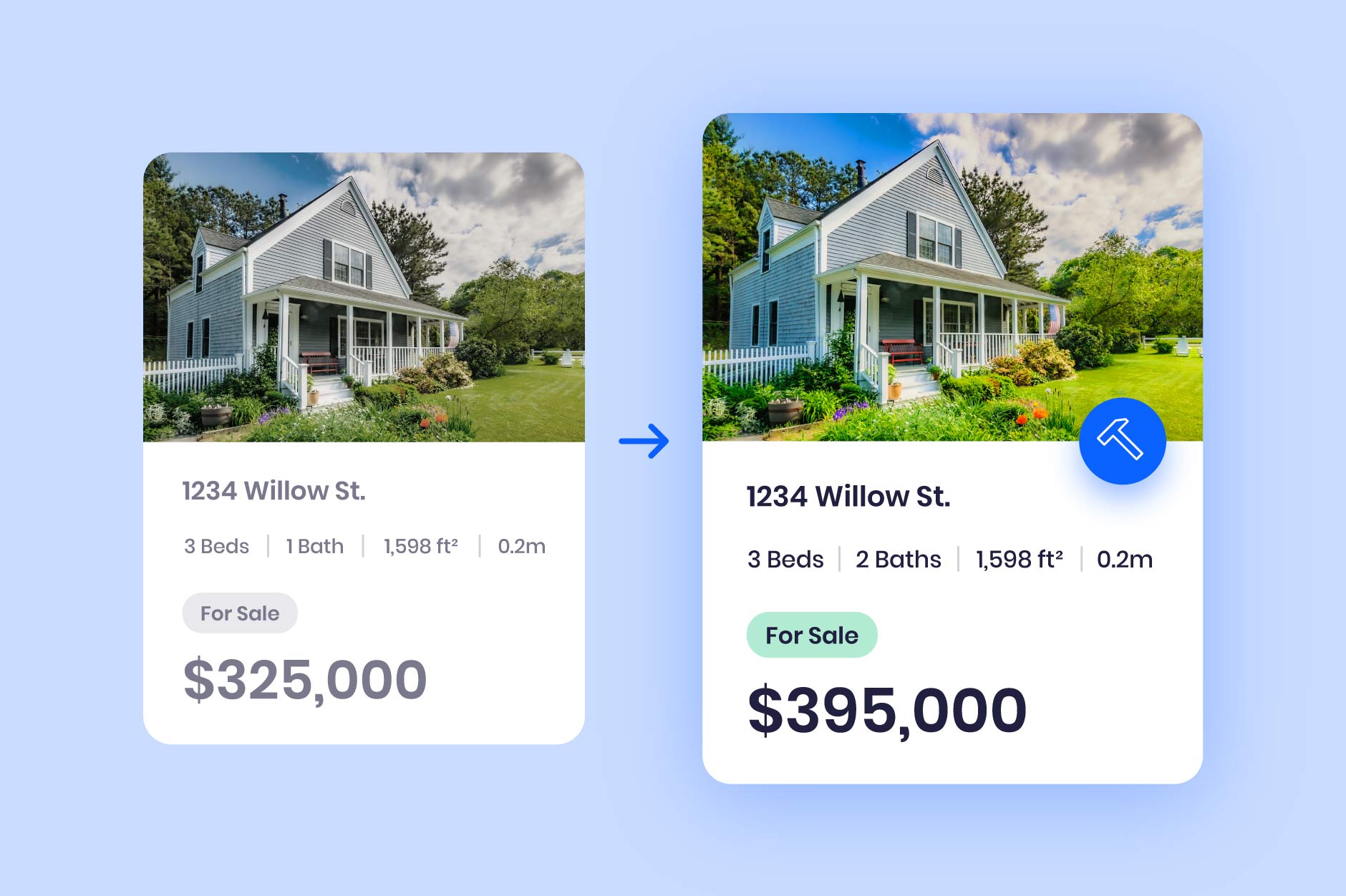
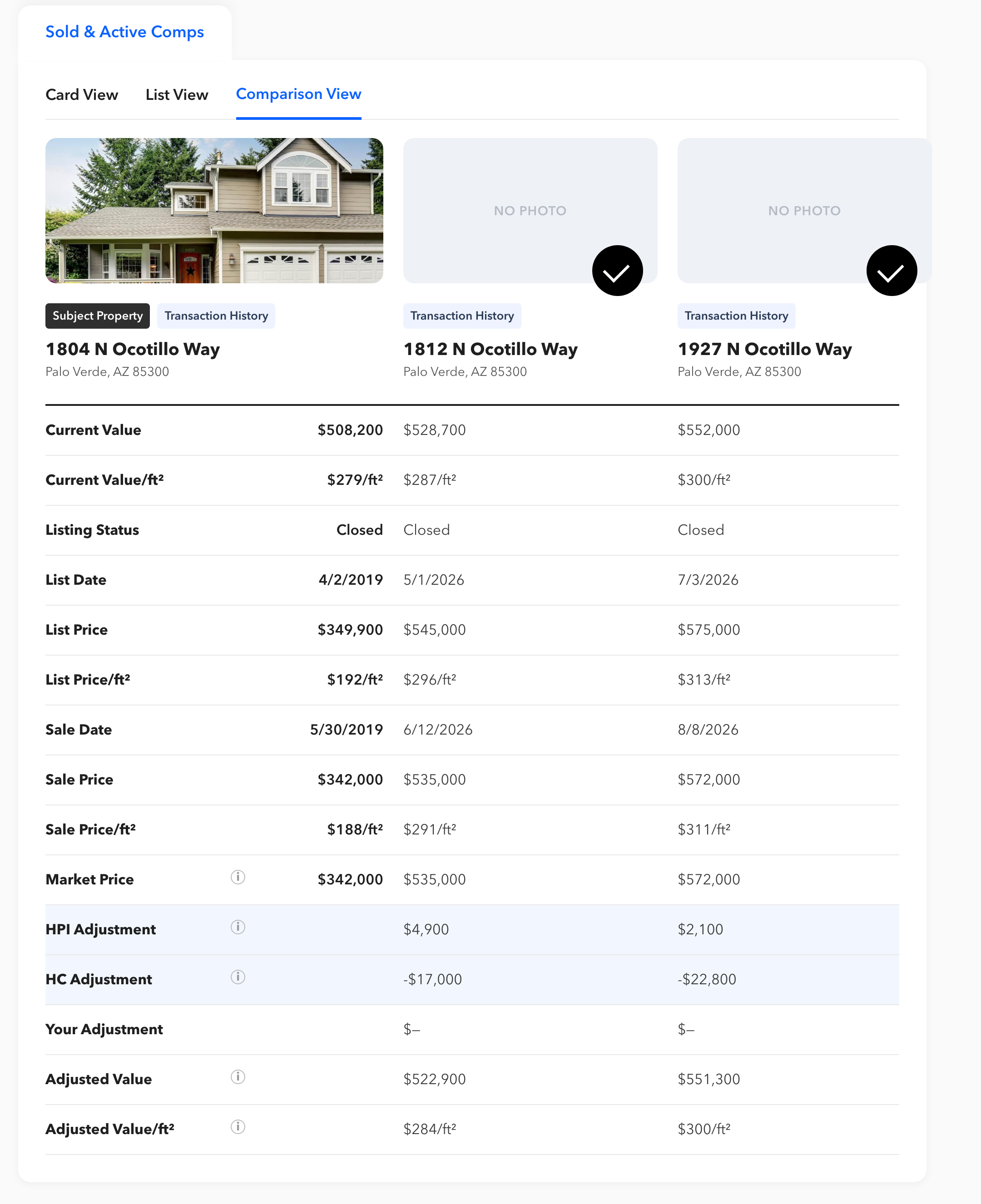
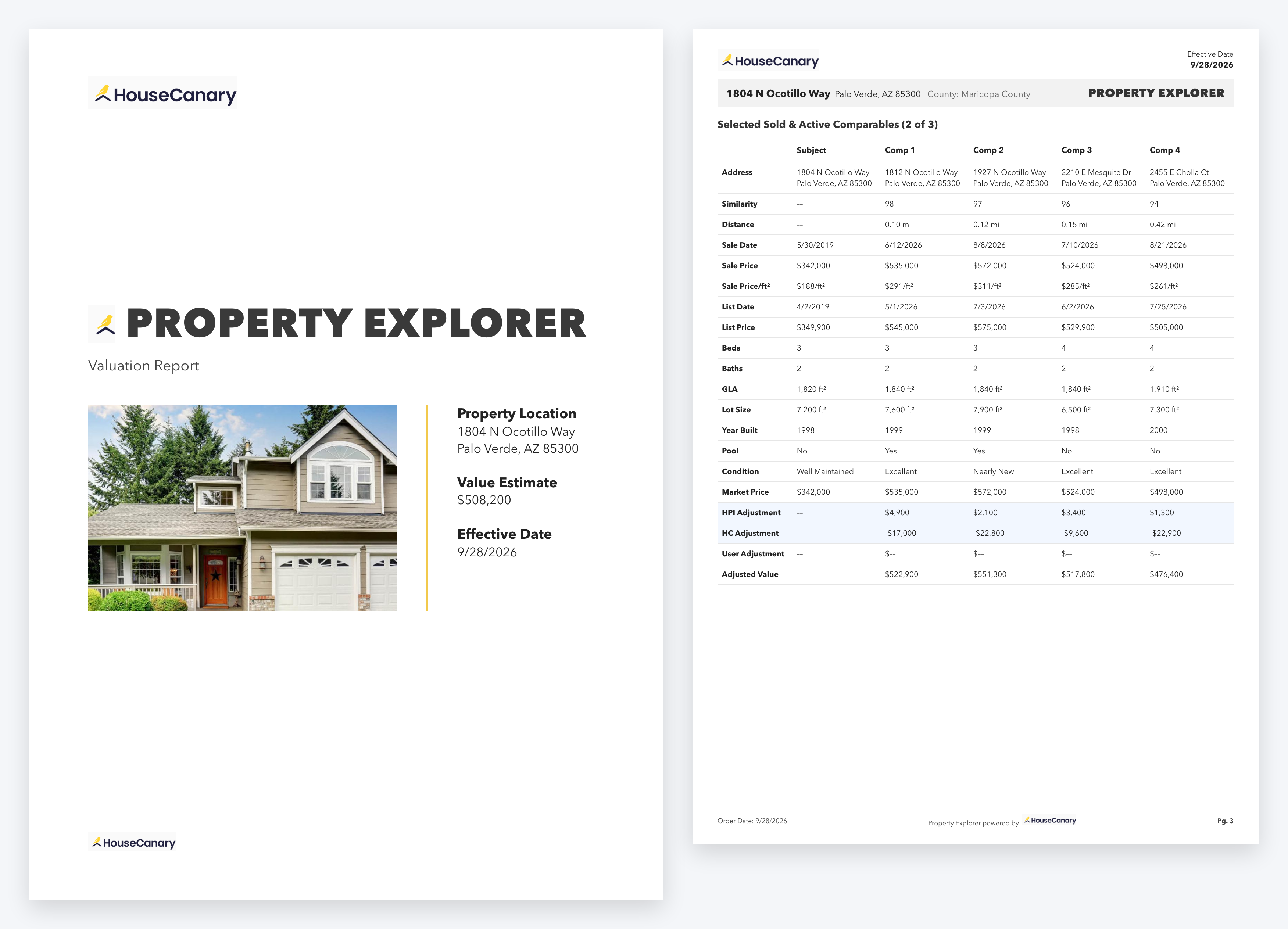
In Property Explorer's Comparison View each comp carries two adjustments: an HPI Adjustment, "a time-based adjustment to match the report effective date," and an HC Adjustment, "an attribute-based adjustment to match the subject property." Sale price plus those two is the Adjusted Value, and on the four comps here it reads $522,900, $551,300, $517,800 and $476,400. The attribute adjustment is one net number per comp, not a feature-by-feature grid, and it can be large, a five-figure swing on a comp that differs in condition or size, which is why the grid above is worth understanding even when the software has done the arithmetic. Add a line in Your Adjustment when you know something the record does not, such as a permitted addition or a new roof.
Step 4: How do you turn the adjusted range into a list price?
Choose the comps, read the range, then position inside it. Property Explorer does the first move for you: its Comparable Value is a straight average of the selected comps' adjusted values, every comp counting the same, so the lever you control is which comps stay selected, not how much each one weighs. Three moves.
Remove weak comps, don't weight them. Because every selected comp counts the same, a weak comp does not get a smaller vote, it gets a full one. Comps 1 to 3 are within 0.15 miles and within 20 square feet of the subject and indicate $501,600 to $514,600. Comp 4 is a larger four-bedroom nearly half a mile out. Leave all four selected and the average is $496,200; deselect Comp 4 and it is $506,800. Keep Comp 4 in the presentation as the floor the market has shown, but take it out of the number.
Check the range against what the market already rejected. Pull the expired listings and the price cuts in the same set. An expired listing at $549,000 in the same subdivision is a price the market has already said no to, and it belongs in the presentation. Pending sales tell you the opposite: what buyers accepted this month, before it shows up as a closed comp.
Position with days on market and list-to-sale ratio. If the segment sells in 30 days at 98% of list, price at the read. If it is 60 days and 95%, price inside the range and say why. For the sample home that supports a list price of $509,900 against a three-comp read of $506,800, with the seller's $572,000 anchor answered in the grid rather than argued across the table. More on those two signals in pricing listings with better valuations.
Which number goes on the report?
Four candidates, and the report lets you pick which one the seller sees as the official price. HouseCanary's Estimated Value, the automated valuation with its confidence range. Adjusted Value, the estimate re-run after you correct the property record with Adjust Fields: the finished basement, the third bath the county never recorded, the pool. The panel shows the difference in dollars, and a checkbox puts the adjusted number on the report. Comparable Value, the straight average of the adjusted values of the comps you left selected. Custom Value, a number you set yourself, flagged in the report as your opinion rather than HouseCanary's, with a reason such as "AVM is underpriced" or "missing property features." Use the estimate when the record is right and the range is tight; use Adjusted Value when the record is wrong; use Comparable Value when you have trimmed the comps to the ones you would defend; use Custom Value when you know something none of the data can, and say what it is.
What do you do when the comps disagree?
When adjusted comps still disagree by more than about 5%, the disagreement is information: the market has not settled on this kind of home. Widen the comp set, check pending sales and expired listings, and lean on a valuation that reports its own confidence range, so you know whether the spread is your comps or the market.
Take the four comps above as a set: $464,500 to $514,600 is a 10% spread, over the line. Drop to the three closest and the spread is under 3%, inside it. That tells you the disagreement came from Comp 4, a larger home farther out, not from the market. Had the three closest still disagreed by 10%, the answer would be different: the market itself is unsettled on this kind of home, and the report should say so.
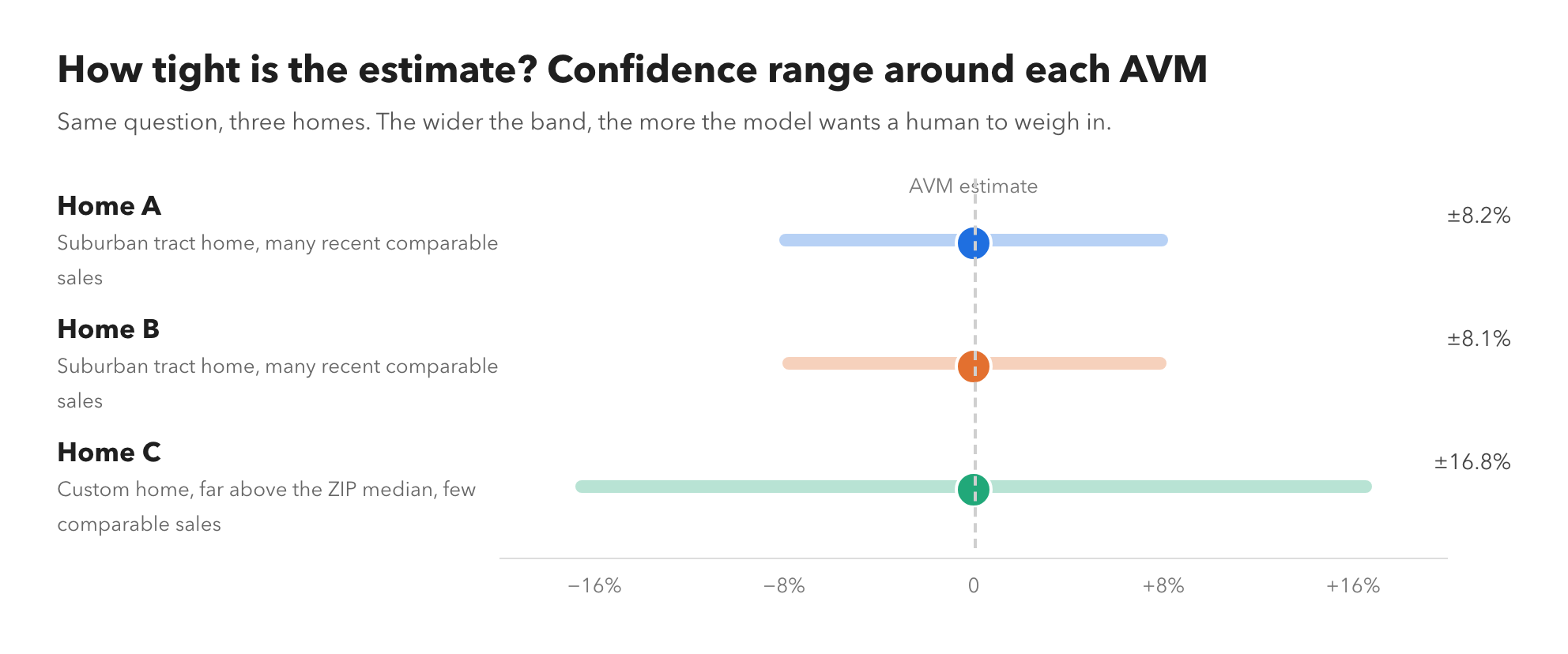
The second check is an automated valuation with a stated error. HouseCanary's value for the sample home is $508,200, range $466,000 to $550,400, forecast standard deviation 0.08, labeled high confidence. The comps-based read of $506,800 sits inside that range, so the two methods agree and you can price with conviction. The range is what a consumer estimate never gives you: tight means the model has seen many sales like this one, wide means it has not, and neither have you. The AVM explainer covers how the range is built, and the one-question CMA walkthrough shows three homes with very different ranges.
What goes in the CMA you hand the seller?
When you write a CMA the seller will keep, it has seven parts, in this order:
- The subject profile. The facts from Step 1, including what the seller has done since purchase. If it is wrong here, nothing after it survives.
- The comps, with the adjustments shown. Three to six sold comps, the grid, the adjusted prices. The grid is the document's credibility; do not summarize it away.
- Active competition. The listings a buyer will tour the same weekend, with their prices and days on market.
- Pending sales and expired listings. What buyers accepted this month, and what the market already refused.
- The market snapshot. Median price, days on market, and months of supply for the ZIP or the segment, with the direction of each.
- The recommended range and list price, with the reasoning. One paragraph. "Three comps within a block indicate $502,000 to $515,000; the market is absorbing this segment in 30 days at 98% of list; I recommend $509,900."
- What would change the number. A remodeled kitchen, a rate move, a competitor cutting price. Sellers who know what would move the number call you before they call the next agent.
Software builds the shell. Property Explorer exports a PDF headed "Valuation Report": value and range, property record, transaction history, comps table and map, comparison pages with adjustments, rental comps, and a market page with months of supply, days on market, and a three-year forecast. It does not write items six and seven. Those are yours, and they are why the seller hired an agent instead of downloading a report. The CMA tool guide compares the software options.
How accurate is a CMA, and what can't it do?
A CMA is only as good as its inputs and its author, and the seller deserves to hear its limits from you.
- It is an opinion of price, not an appraisal. The Consumer Financial Protection Bureau defines an appraisal as "a written document that shows an opinion of how much a property is worth," an independent assessment the lender obtains. A CMA is the agent's opinion for the seller. A lender will order an appraisal regardless, and it can come in below your number. Price so that it does not have to.
- It cannot see interior condition or unpermitted work unless you walk the house and the comps. The MLS photo of a comp's kitchen is a marketing photo.
- In the 12 non-disclosure states, public sale prices are thin. Comps there lean on MLS data and modeled values, and the range widens accordingly. The non-disclosure states guide explains what that does to comps.
- It is only as fresh as its newest comp. A 90-day window in a market moving 1% a month is a 3% error before you adjust anything.
- It does not publish its own error. A HouseCanary automated valuation carries a stated median error, 2.7% on homes after they list and 7.5% before, and a confidence range on every estimate. A CMA has no such number. That is not a weakness of the method, it is a reason to run both.
- It will not price a one-of-a-kind home. When there are no comparable sales, the honest CMA says so and widens to the model, the pending sales, and the seller's patience.
FAQ
How long does a CMA take?
An experienced agent can build one in one to two hours with software doing the comp pull and the export, longer for an unusual home or a thin market. The walk-through of the subject property is the part not to shorten.
How much does a CMA cost?
Sellers get a comparative market analysis from an agent at no charge; it is part of winning the listing. The cost sits with the agent, in data and software. HouseCanary agent plans start at $190 a year and include the valuation, comps, and report export shown in this post.
How many comps do you need for a CMA?
Three to six closed sales is the working range. Below three the result is a guess; above six you are averaging away the closest evidence. Software will put active and pending listings in the set at their list price; keep an active selected only when it is the home your seller will be compared against.
What is the difference between a CMA, an appraisal, and an AVM?
A CMA is an agent's opinion of the likely sale price, built from adjusted comps. An appraisal is a licensed appraiser's opinion of value for a lender, under formal standards. An AVM is a model's estimate from sales, records, and market data, delivered instantly with a confidence range. Agents use the AVM to check the CMA; lenders use the appraisal.
Can I hand the seller the HouseCanary CMA as is?
In most cases, yes. The report already carries the subject profile, the selected comps with time and property adjustments, the range, the market snapshot and the forecast, so the agent's work drops from building the analysis to choosing the number and explaining it. Adjust comps or set your own opinion of price when you know something the record does not.
Can you do a CMA without MLS access?
Yes. A data platform with public records, listing history, and a valuation model gives you the subject profile, sold comps, and a confidence range without an MLS login. You lose the remarks and the agent-only fields, so walk the comps you can and lean on the range for the ones you cannot.
Run the four steps on a listing you already know
Test this on a home whose price you already have an opinion about. Pull the profile, let the software pick the comps, adjust the four closest, and read your number against the confidence range. If they agree, you have a CMA you can defend in an hour. If not, you learned something before the seller did. HouseCanary for real estate agents includes the valuation, comps, and report export behind every figure in this post, with plans at agent pricing.