

Table of Contents

HouseCanary
Know what any property is really worth.
AVMs with a 2.7% median error, plus the comps and forecasts agents and investors rely on.
Explore PlansHigher interest rates and tighter underwriting have made real estate investing more complex in 2026, with uneven market performance and tight inventory putting extra pressure on financing decisions. Combined with rising investor interest, the market is increasingly competitive; even minor errors in selecting or structuring property loans can put an investment at risk.
In this environment, thorough research into investment property financing is critical. Choosing the right loan type and accurately estimating down payments and cash reserves can be the difference between closing a high-potential deal and watching a lucrative opportunity slip away.
This post explores today’s financing landscape, the criteria lenders evaluate, and how property data and analytics help investors make smarter, data-backed property loan decisions.
How Investment Property Financing Works
Investment property financing differs from primary residence mortgages because lenders take on more risk and expect the property to generate income. That’s why underwriting is stricter, with closer attention to factors like cash flow potential, the amount of debt relative to the property’s value, and the borrower’s relevant experience.
Accurate valuations and rental income analysis are essential to structuring a successful deal. Strong comps, projected post-renovation values, and local market trends inform loan terms and expected returns.
Investors who combine predictive analytics with real-time market data can pinpoint properties that hit their yield targets, fine-tune financing structures, and reduce exposure to market fluctuations.
Interest Rates and Terms for Properties
Investment property loan requirements are generally higher than primary residence mortgages, reflecting the additional risk lenders take on. Key considerations include:
- Rate differences: Typical rates are 0.5-2% higher than for primary homes, depending on property type, location, and borrower experience.
- Fixed-rate loans: Provide predictable payments, ideal for long-term hold properties.
- Adjustable-rate loans: Often lower initial costs, suited for short-term investments or flips, but carry the risk of rising payments over time.
- Market influences: Broader economic conditions, lender competition, and regional trends impact rates. Investors can leverage real-time data and predictive analytics to time financing and secure terms aligned with cash flow goals and exit strategies.
Types of Property Financing Options
Today’s investors have a wide range of financing options, each shaping cash flow, risk, and growth potential in different ways. Knowing how to use these tools strategically helps you structure deals and scale your portfolio efficiently.
The table below highlights the typical down payments for the most common property financing options, as well as the investor types or strategies each supports:
| Financing Type | Typical Down Payment | Best For |
|---|---|---|
| Conventional Loans | 20–25% | Long-term rental investors |
| Portfolio Loans | 20–30% | Investors with non-traditional income or multiple properties |
| FHA Loans (House Hacking) | 3.5% | Investors living in one unit and renting out others (2–4 units) |
| DSCR Loans | 20–25% | Rental investors qualifying based on property cash flow |
| Hard Money Loans | 20–30% | Fix-and-flip or short-term investments |
| Private Loans (including Seller Financing) | Varies | Flexible or relationship-based financing |
| Bridge Loans | 20–30% or equity-based | Short-term transitional financing |
| Home Equity Loans / HELOCs / Cash-Out Refinance | Varies | Investors leveraging existing home equity |
| Commercial Loans (Fannie / Freddie / FHA Multifamily) | 25–30% | Multifamily properties (5+ units) |
| SBA Loans | 10–20% | Owner-operated commercial real estate or business facilities |
1. Conventional Investment Property Loans
Typical down payment: 20-25%
Conventional loans are a go-to for long-term rental investors seeking predictable financing and competitive rates. Lenders evaluate borrower credentials and the property’s income potential, making accurate valuations and market data essential.
Comparable sales, property condition, and local trends inform loan terms and expected returns. Investors who use predictive analytics structure conventional loans to optimize cash flow, manage risk, and support portfolio growth.
2. Portfolio Loans
Typical down payment: 20-30%
Portfolio loans are kept on a lender’s balance sheet, allowing more flexible underwriting than conventional financing. Investors often use them with multiple properties, non-traditional income, or more complex portfolio strategies.
Because risk is evaluated at the property level, lenders place greater emphasis on cash flow and valuation accuracy, and local market conditions. Investors who support deals with strong portfolio monitoring and clear performance assumptions are better positioned to secure favorable terms and scale their portfolios efficiently.
3. FHA Loans for Investment Properties
Typical down payment: 3.5%
Federal Housing Administration (FHA) loans support investment strategies through owner-occupied 2-4 unit properties, commonly known as house hacking. Investors who live in one unit and rent out the others can access lower down payment requirements while generating rental income.
These loans are limited to properties where the borrower occupies a unit, making them unsuitable for purely passive investments. Accurate rental assumptions and unit valuations let owner-occupant investors maximize income potential while staying within occupancy rules.
4. DSCR Loans
Typical down payment: 20-25%
Debt Service Coverage Ratio (DSCR) loans qualify borrowers primarily on a property’s ability to generate income, rather than on personal income or traditional debt-to-income ratios. Because approval hinges on projected rental yield, investors can often get property financing without relying as heavily on personal financial documentation.
To provide precise valuations to lenders, investors need realistic rent estimates and accurate expense projections. These projections reduce investor exposure and help loan officers negotiate terms effectively.
Lenders also closely examine local rental demand and market conditions to confirm cash flow assumptions.
5. Commercial Real Estate Loans
Typical down payment: 25-30%
Commercial real estate loans are often underwritten using property-level cash flow, similar to DSCR loans, with income modeling playing a central role in qualification. Lenders evaluate whether projected rents cover operating expenses, debt service, and reserves, placing less emphasis on personal income.
These loans are best suited for larger rental properties or multi-unit buildings, including 5+ unit multifamily properties, owner-operated commercial real estate, and business facilities.
Common financing options include:
- Fannie Mae and Freddie Mac multifamily programs
- FHA multifamily loans
- SBA loans
Detailed income modeling and market data allow investors to ensure projected rents cover expenses, debt service, and reserves for larger, multi-unit properties.
6. Hard Money and Private Loans
Typical down payment: 20-30%
Hard money and private loans are short-term, asset-based financing options that prioritize the property’s value over the borrower’s income or credit history. Unlike DSCR or commercial loans, which evaluate long-term cash flow and portfolio-level performance, these loans are designed for speed, ideal for fix-and-flip projects or time-sensitive acquisitions.
Because interest rates and fees are higher and repayment timelines are shorter, hard money loans carry greater financial risk if projects take longer than expected or market conditions shift. By analyzing property valuations and local comparables, investors can mitigate the higher costs and short repayment risks of hard money projects.
7. Bridge Loans
Typical down payment: 20-30%
Bridge loans are short-term, transitional financing used to cover gaps between buying and selling properties or to secure a new acquisition while arranging permanent financing. Unlike hard money loans, which prioritize speed and often fund fix-and-flip or renovation projects, bridge loans are typically used for bridging timing or liquidity gaps in an investor’s portfolio.
Because these loans are temporary and carry higher costs, reliable valuations and market forecasts help investors time acquisitions and sales strategically, reducing the risk of overpaying or cash flow gaps.
8. HELOCs and Home Equity Loans
Typical down payment: Varies
Home Equity Lines of Credit (HELOCs) and home equity loans let investors access the equity in existing properties to fund new acquisitions, renovations, or other investment opportunities. Unlike DSCR or commercial loans, these options leverage your current assets, providing flexible financing without relying solely on rental income.
Investors should consider the risks of adding debt to an existing property, navigating variable interest rates, and meeting lender requirements on loan-to-value ratios and credit. Careful analysis of property equity and cash flow ensures these loans fund acquisitions or renovations without over-leveraging existing assets.
9. SBA Loans
Small Business Administration (SBA) loans are government-backed financing programs that help small business owners purchase or refinance commercial real estate or business facilities. These loans are tied to an owner-operated business (not purely rental income, and the business’s financials play a central role in qualification.
SBA loans typically offer lower down payments and longer repayment terms than hard money or bridge loans, making them a strategic option for investors looking to acquire or expand business properties. Revenue projections and property valuations help investors confirm that business-backed properties can safely support debt and growth objectives.
How to Apply for Investment Property Financing
Positioning your deal is important when financing investment property. In a tighter lending environment, lenders expect you to have a clear view of your financial capacity and realistic projections for how the property will perform.
The application process typically follows these core steps, designed to help lenders assess risk and deal viability.
1. Clarify Your Investment Strategy
Objective: Define your plan to guide loan selection and underwriting.
Define whether the asset is a long-term rental, value-add play, or short-term hold. Your strategy influences loan selection, terms, leverage, and underwriting expectations.
2. Prepare Your Borrower Profile
Objective: Show lenders you can execute and manage risk.
Your borrower profile directly influences investment property loan rates and approval likelihood.
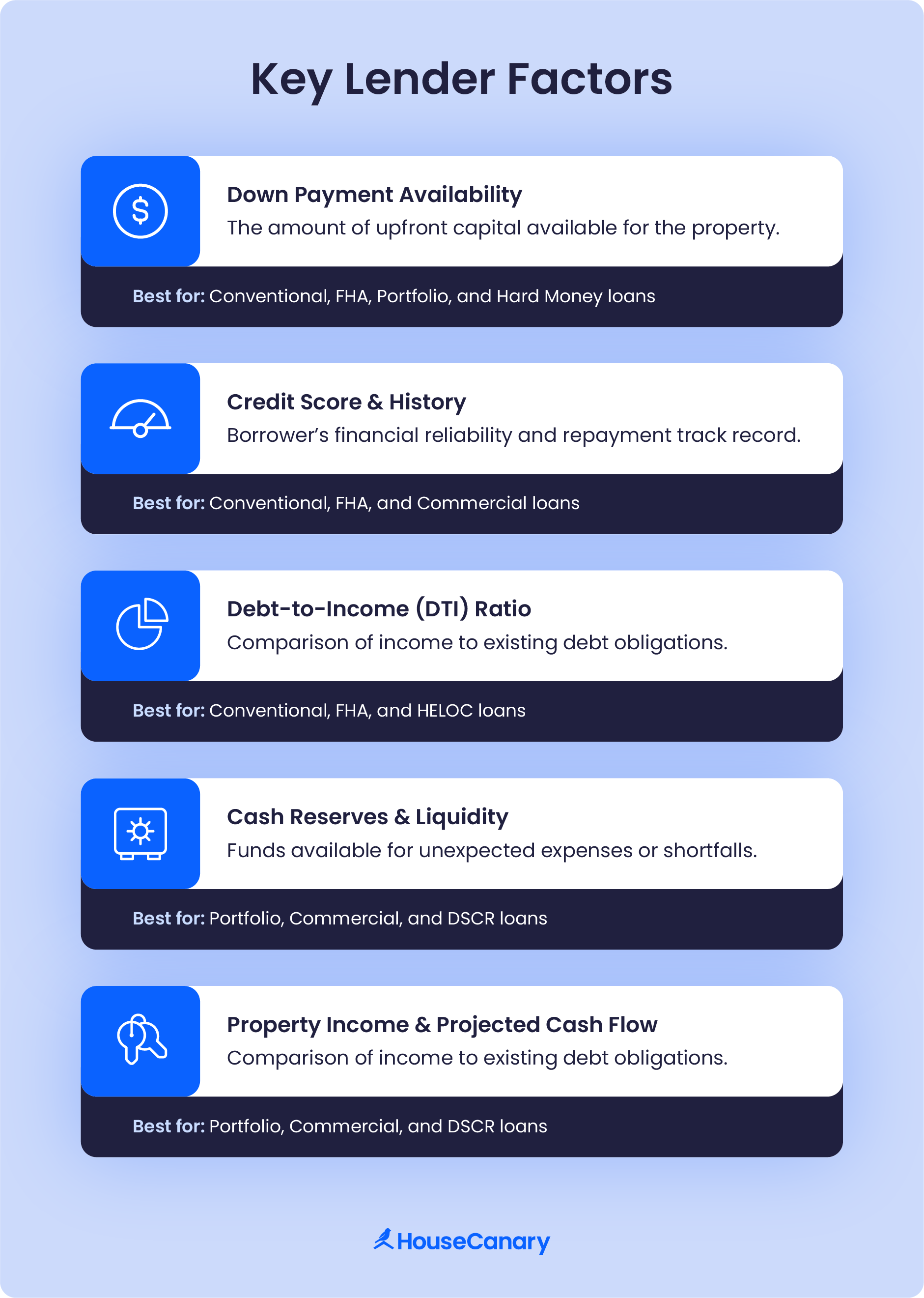
Key factors typically include:
- Down payment availability
- Credit score and credit history
- Debt-to-income (DTI) ratio
- Cash reserves and liquidity
- Property income and projected cash flow
3. Underwrite the Property Like a Lender
Objective: Prove the investment can generate a reliable cash flow.
Create realistic rental income projections, operating expense estimates, and cash flow assumptions using automated investment valuation models.
These figures should be supported by market data, particularly for loans where property performance drives approval.
4. Validate Property Value and Market Conditions
Objective: Confirm the numbers with reliable data.
Use appraisals, comparable sales, and local market trends as insights for loan sizing, leverage, and pricing. Data-backed valuations help reduce underwriting friction and execution risk.
5. Submit Documentation and Finalize Terms
Objective: Lock in financing that supports your investment goals.
Once underwriting confirms a deal, lock in the loan structure, pricing, and timelines based on lender requirements and current market conditions.
Approaching financing with lender-grade assumptions and reliable property data positions you to secure terms that support returns, manage risk, and scale efficiently in a competitive market.
How Data Supports Investment Property Financing Decisions
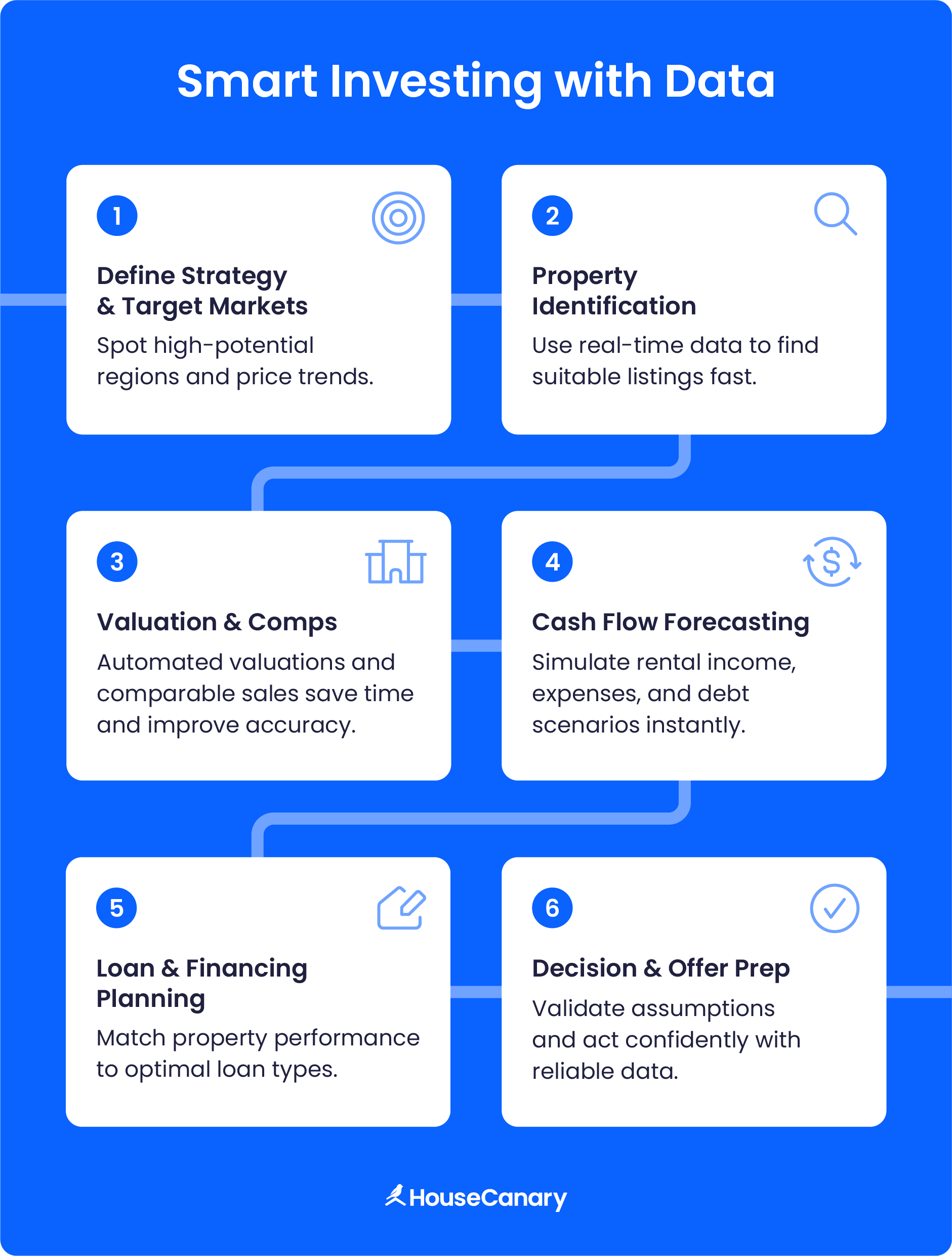
With investment property financing more competitive than ever, having fast, accurate data is the difference between closing a deal and missing out. Property analytics help investors and lenders reduce risk, validate assumptions, and make more confident, timely financing decisions.
Key ways to leverage data in your investment research include:
- Valuations: Use accurate property valuations and comparable sales to determine fair purchase prices and ensure your offer aligns with market trends and lender expectations.
- Forecasting and cash flow modeling: Build a comprehensive rental property financial model to analyze historical and projected income, ensuring the property covers expenses, debt obligations, and targeted returns.
- Market insights: Track inventory, demand, and regional trends to identify competitive markets, spot emerging opportunities, and decide where to focus your investment dollars.
Lenders rely on the same property data to guide underwriting decisions. They assess and reduce default risk by analyzing valuations and local market trends like rental income projections.
Recent data shows inventory growth slowing while buyer demand remains steady, underscoring the need for accurate property analytics to streamline research and risk assessment. With tools like HouseCanary, lenders and investors can access these insights quickly to make confident investment decisions.
How to Choose the Right Investment Financing
Choosing the right financing starts with knowing your investment strategy. Whether it’s a long-term rental, short-term flip, or value-add play, your goals determine which data points matter and which financing options make sense.
Consider these factors when evaluating loan options:
- Investment strategy & hold period: Different loan structures suit long-term rentals, flips, or value-add plays.
- Property type & location: Single-family, multifamily, and commercial properties have unique lender requirements, and local market trends influence rates and risk.
- Risk tolerance: Some investors prioritize predictable payments, while others leverage loans tied to property performance, like DSCR or portfolio loans.
- Cash flow objectives: Ensure projected rental income and expenses cover debt service and support your financial goals.
- Portfolio fit: Choose financing that complements your broader strategy without overextending resources.
Once your strategy is clear, using AI-driven investment tools like HouseCanary makes it easy to analyze properties, validate assumptions, and compare financing options, turning insights into clear, actionable investment decisions.
Support Smarter Property Investing with HouseCanary
Data plays a central role in the investment property financing process, helping investors assess risk and structure deals that support their goals. Accurate valuations, income projections, and market insights give you a clear picture of a property’s potential and if it fits your strategy.
Platforms like HouseCanary make this faster and easier to access by providing reliable property analytics and market intelligence.
You can use this data to confidently evaluate opportunities and make well-researched investment decisions, or strengthen your position with lenders.
Get started with Investment Property Data today to make well-informed decisions while potentially optimizing investment property loan rates.
FAQ about Investment Property Financing
What Is the Best Loan for an Investment Property?
The best loan for an investment property depends on your goals and the type of property. Choosing financing that fits your strategy, cash flow needs, and comfort with risk helps your investment succeed without adding unnecessary challenges.
How Much Down Payment Is Required for Investment Property Financing?
Down payment requirements vary by loan and property type, but investors typically need 20-30% of the purchase price. Some programs, like FHA loans for owner-occupied units, may require less, while short-term or higher-risk loans often demand more upfront.
How Do Lenders Evaluate Investment Properties?
Lenders assess investment properties primarily based on their income potential and market value. They use real estate investment software to review factors, like property condition, comparable sales, rental income projections, and local market trends, to determine risk and set loan terms.
What Salary Do You Need for an Investment Property?
There’s no fixed salary requirement, as lenders focus more on your overall financial profile, including credit, cash reserves, and the property’s projected income.
Requirements can vary depending on the type of property and loan, with smaller residential properties often relying more on personal income and larger multifamily or commercial loans focusing heavily on property cash flow. Your ability to cover the down payment, mortgage, and other expenses is what matters most.