

Table of Contents

HouseCanary
Know what any property is really worth.
AVMs with a 2.7% median error, plus the comps and forecasts agents and investors rely on.
Explore PlansReal estate lead generation has shifted from buying more leads to building durable growth assets—and using data to work smarter. The best lead generation strategies are no longer defined by volume alone, but by how effectively agents identify and prioritize high-probability opportunities, often informed by an AI real estate forecast.
For many agents, the issue isn’t effort, it’s efficiency. Rising ad costs, inconsistent pipelines, and over-reliance on portals make it harder to convert opportunities into consistent revenue.
The ability to instantly access and analyze property and market data can make the difference between reactive prospecting and a more strategic lead generation approach. This is especially true when advising clients on pricing, investment opportunities, or investment property financing decisions.
This guide breaks down the best lead generation for realtors by strategy type and business stage, helping you balance inbound visibility, paid acceleration, and predictive intelligence.
The 3 Types of Real Estate Lead Generation (and Why Most Agents Over-Rely on Just One)
Not all real estate lead generation strategies operate under the same principles. Some build long-term visibility, others deliver short-term volume, and some improve how agents identify opportunities altogether.
Yet many agents concentrate too heavily on a single channel, creating pipeline volatility and rising acquisition costs.
The most resilient businesses layer multiple lead generation models.
Combining inbound, paid, outbound, and data-driven strategies reduces dependency on any single source and improves consistency and conversion quality.
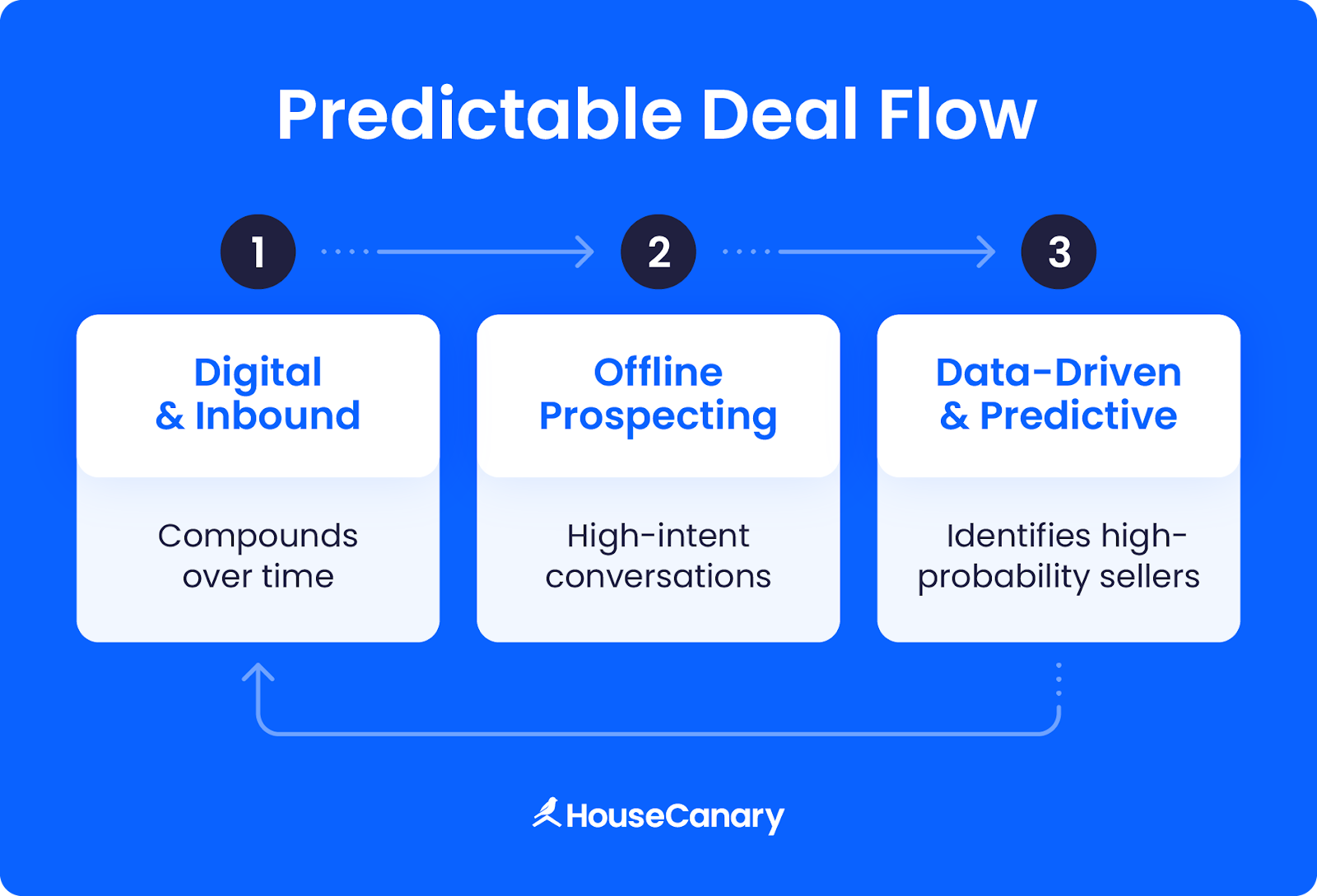
1. Digital & Inbound Lead Generation
Digital and inbound lead generation channels focus on attracting prospects through platforms you own and control. These channels prioritize long-term visibility and brand equity.
Common examples include:
- SEO-driven blog and neighborhood content
- Email marketing and database nurturing
- Social media marketing and organic engagement
- Website IDX search and registration capture
- Lead magnets such as home valuations and buyer guides
These strategies typically compound over time, building a more predictable organic pipeline rather than delivering immediate volume.
2. Offline & Outbound Prospecting
Offline and outbound prospecting centers on proactive, agent-driven outreach.
Common methods include:
- Open houses
- Expired listings
- FSBO outreach
- Door knocking
- Sphere-of-influence referrals
Note: These strategies demand consistency and persistence, yet often produce strong conversion rates when executed systematically.
3. Data-Driven & Predictive Lead Generation
Data-driven and predictive strategies enhance how agents identify and prioritize opportunities.
Examples include:
- Targeting high-equity properties
- Identifying homeowners likely to sell
- Optimizing geographic farming using analytics
- Supporting listing presentations with defensible market data
Rather than waiting for prospects to self-identify, predictive insights help agents focus on properties with a higher probability to transact—improving efficiency, conversion confidence, and ROI.
In some markets, ZIP code–level forecasts are already projecting double-digit home price growth exceeding 10% over the next 12 months, helping professionals identify emerging opportunities earlier.
The table below summarizes how these pillars contribute to pipeline stability and growth. Read more for a breakdown of the best real estate lead generation websites.
Best Lead Generation Platforms Overview
| Tool | Best For | Pricing | Lead Type and Quality | Benefits |
|---|---|---|---|---|
| HouseCanary | Agents targeting likely sellers with predictive data | Starts at $19/month | Data-driven targeting insights; identifies higher-probability seller opportunities rather than delivering direct leads |
|
| Zillow Premier Agent | Agents seeking immediate buyer leads | Varies by ZIP code and competition | Active buyer inquiries from portal traffic; exclusivity and quality vary by market |
|
| SmartZip | Listing agents using predictive seller analytics | Custom pricing based on territory | Predictive seller targeting within geographic farms |
|
| CINC | Teams scaling with paid ads and CRM automation | Custom pricing + ad spend | PPC-generated buyer and seller inquiries; quality tied to campaign execution |
|
| REDEX | Agents prospecting expired listings and FSBOs | Subscription-based by data category | Expired listings, FSBO, and other outbound prospecting data |
|
| Market Leader | Solo agents wanting steady monthly lead flow | Subscription model based on volume | Buyer and seller leads delivered monthly; typically shared or semi-exclusive |
|
1. HouseCanary
Best for: Agents targeting likely sellers with predictive data
HouseCanary’s data analytics and valuation tools help agents move beyond traditional lead generation by turning property and market data into actionable insights. Instead of relying solely on inbound inquiries or purchased lead lists, agents can analyze property-level signals, valuation trends, and local market intelligence to identify homeowners who may be more likely to transact
This approach strengthens geographic farming strategies, improves prospecting efficiency, and helps agents spot off-market leads using predictive data, creating earlier, more strategic outreach opportunities.
Through HouseCanary’s Data Analytics & Valuations solution, agents gain access to AI-powered automated valuation models (AVMs), neighborhood market trends, and predictive insights. HouseCanary’s AVM leverages data from more than 120 million residential properties and delivers valuations in seconds, helping agents move faster when evaluating opportunities.
The platform’s valuation models are designed for institutional-grade accuracy and are measured using metrics such as median absolute percentage error (mdAPE), helping agents support listing presentations with defensible pricing insights and deeper property intelligence.
These capabilities allow agents to prioritize higher-probability opportunities, engage homeowners with more informed market conversations, and build stronger prospecting strategies over time.
Pricing: Basic plan $19/month

2. Zillow Premier Agent
Best for: Agents seeking immediate buyer leads
Zillow Premier Agent connects agents with active buyers searching on Zillow’s consumer platform. Agents purchase exposure in specific ZIP codes, allowing them to receive inquiries tied to listings in those areas.
Because Zillow attracts high consumer traffic, the platform can generate consistent buyer inquiries in competitive markets.
However, this model focuses on capturing demand after buyers have already begun their search, which means agents often compete with other advertisers for the same inquiries. Lead exclusivity and pricing vary by location, and performance frequently depends on speed-to-lead, follow-up systems, and the level of competition within a ZIP code.
Compared with data-driven prospecting strategies that help identify opportunities earlier in the transaction cycle, portal-based leads are typically more reactive and subject to fluctuating advertising costs.
Pricing: Pricing varies by ZIP code and market demand. Costs typically scale with competition and the share of voice purchased.
3. SmartZip
Best for: Listing agents using predictive seller analytics
SmartZip is one of the best seller lead generation for realtors, focusing on identifying homeowners who are more likely to sell within a defined timeframe. Using predictive modeling, the platform scores properties based on transaction probability, helping agents prioritize outreach within geographic farming territories.
This approach can be useful for listing-focused agents who want to concentrate marketing efforts on specific neighborhoods.
However, SmartZip’s predictive insights are typically tied to defined territories and marketing programs, which can limit flexibility for agents who want broader property-level analytics or deeper valuation insights across multiple markets.
Pricing: Custom pricing based on territory size and data volume. Typically structured as a higher-investment seller-focused solution.
4. CINC
Best for: Teams scaling with paid ads and CRM automation
CINC combines paid digital advertising with built-in CRM and lead nurturing tools, making it a common option for teams focused on scaling inbound lead flow. The platform manages Google and social media campaigns designed to capture buyer and seller inquiries and routes those leads directly into automated follow-up workflows.
Because CINC relies heavily on paid advertising, performance is closely tied to campaign management, ad budgets, and ongoing optimization. Teams evaluating this approach often consider how well their marketing stack integrates with other systems—such as property data platforms or real estate APIs—to improve visibility into market insights and property-level intelligence.
As with any paid acquisition model, success depends on:
- Disciplined budget management
- Conversion processes
- Consistent follow-up execution
Pricing: Custom pricing based on team size, services, and ad spend. Typically requires a meaningful monthly marketing budget.
5. REDEX
Best for: Agents prospecting expired listings and FSBOs
REDEX provides access to prospecting data, including expired listings, for-sale-by-owner properties, and geographic lead lists. It supports agents who prefer direct outreach to homeowners who have already signaled potential selling intent.
While these datasets can help agents identify motivated sellers, the model primarily surfaces opportunities after a listing attempt or selling decision has already occurred. Success often depends on persistence, strong scripts, and consistent outreach.
Pricing: Subscription-based pricing varies by data category selected (expired listings, FSBOs, geo leads, etc.).
6. Market Leader
Best for: Solo agents wanting steady monthly lead flow
Market Leader provides a bundled lead generation and CRM platform designed to deliver a consistent flow of buyer and seller inquiries each month. For agents evaluating lead generation platforms, it is often considered for its predictable, subscription-based approach.
Agents receive leads directly into an integrated follow-up system, helping streamline contact management and nurture workflows without requiring a complex tech stack. However, as with many lead-delivery platforms, agents typically compete within shared lead pools and rely on response speed and follow-up discipline to convert opportunities.
Monitoring broader housing market predictions can help agents better time outreach and prioritize opportunities in their pipeline.
Pricing: Subscription model with tiered pricing based on lead volume and service level.
Top Strategies to Boost Leads
While platform selection and core lead generation pillars shape long-term growth, day-to-day pipeline performance often improves through consistent, relationship-driven activities.
Agents who align outreach with real estate market trends and local insights tend to create more relevant conversations and higher engagement.
These complementary strategies help reinforce visibility, credibility, and conversion opportunities across both inbound and outbound efforts.
Share Local Market Expertise Publicly
Consistently publish insights about neighborhood activity and housing trends to position yourself as a trusted local expert. Content that explains what is happening in the market often attracts more engagement than promotional posts alone.
For instance, recent housing forecasts show that mid-sized, more affordable markets are often projected to experience faster price appreciation than many major metros, highlighting how localized data can reveal emerging trends.
Examples include:
- Sharing neighborhood updates and listing highlights
- Publishing short-form video and client success stories
- Commenting on local real estate market trends
Takeaway: Consistency and insight build credibility. Data-backed insights from platforms like HouseCanary can also help agents share more informed commentary on local real estate market trends.
Build a Local Referral Network
Strong referral pipelines often start with trusted relationships. Connecting with professionals who regularly interact with homeowners can generate steady introductions.
Consider partnering with:
- Mortgage brokers
- Title representatives
- Home stagers
- Financial advisors
Takeaway: Referral pipelines often produce higher conversion rates. Data-driven insights can also strengthen conversations with past clients and partners, particularly investors who rely on real estate investment software to evaluate property opportunities.
Increase Community Visibility
Real estate is a relationship-driven business. Consistently showing up in your community helps people become familiar with your name and expertise.
Ways to increase visibility include:
- Attending Chamber of Commerce events
- Participating in local business meetups
- Supporting charity and civic functions
Takeaway: Familiarity builds trust, which supports long-term lead flow.
Nurture Your Database Consistently
Your database is one of your business's most valuable assets. Regular communication helps maintain relationships and ensures you stay top-of-mind when someone decides to move.
Effective communication may include:
- Market updates
- Just-listed / just-sold alerts
- Buyer and seller resources
Takeaway: Consistent, value-driven communication strengthens recall and engagement. Incorporating local market insights and property data can make updates more useful and actionable for your audience.
Turn Open Houses Into Lead Opportunities
An open house should serve as a structured lead-generation event, not just a showing for a single listing.
To maximize results:
- Capture visitor information
- Engage neighbors who may become future sellers
- Follow up with attendees quickly
Takeaway: A well-executed open house can generate both buyer and future seller opportunities. Property data and neighborhood insights can also help agents answer pricing and market questions with greater confidence.
Combine Short-Term and Long-Term Demand Capture
Successful lead generation often blends immediate visibility with long-term discovery.
Examples include:
- Running Google Ads for high-intent searches
- Using social ads for awareness and retargeting
- Publishing SEO content that compounds traffic over time
Takeaway: A blended approach reduces dependence on any single lead source.
Activate Your Sphere of Influence
Past clients, friends, family, and local connections already know and trust you. Proactively engaging this network often leads to higher-quality referrals.
Ways to strengthen this channel include:
- Asking for introductions
- Hosting client appreciation events
- Maintaining consistent outreach
Takeaway: Referral-driven business typically produces higher conversion rates and stronger client relationships.
Capture Demand Through Third-Party Platforms
Rented attention strategies rely on third-party platforms or purchased databases. They can accelerate lead flow but offer limited ownership and control.
Typical sources include:
- Portal advertising
- Purchased lead lists
- Shared buyer inquiries
Takeaway: While these channels may generate immediate visibility, agents pay for exposure they do not own. Costs often increase with competition, and lead quality and exclusivity can vary.
Generate Targeted Demand With Paid Campaigns
Paid digital advertising captures targeted demand using precise audience and intent-based targeting.
Examples include:
- Google Ads
- Facebook and Instagram campaigns
- Retargeting strategies
Takeaway: Paid campaigns offer strong scalability but require disciplined budget management, creative optimization, and rapid follow-up systems. Performance often depends on execution quality and conversion processes.
How to Choose the Right Lead Generation Strategy
The best real estate leads for agents often come from choosing a mix of strategies rather than relying on a single source.
As more professionals adopt AI tools for real estate agents, decision-making is increasingly shaped by data, automation, and predictive insights rather than guesswork alone.
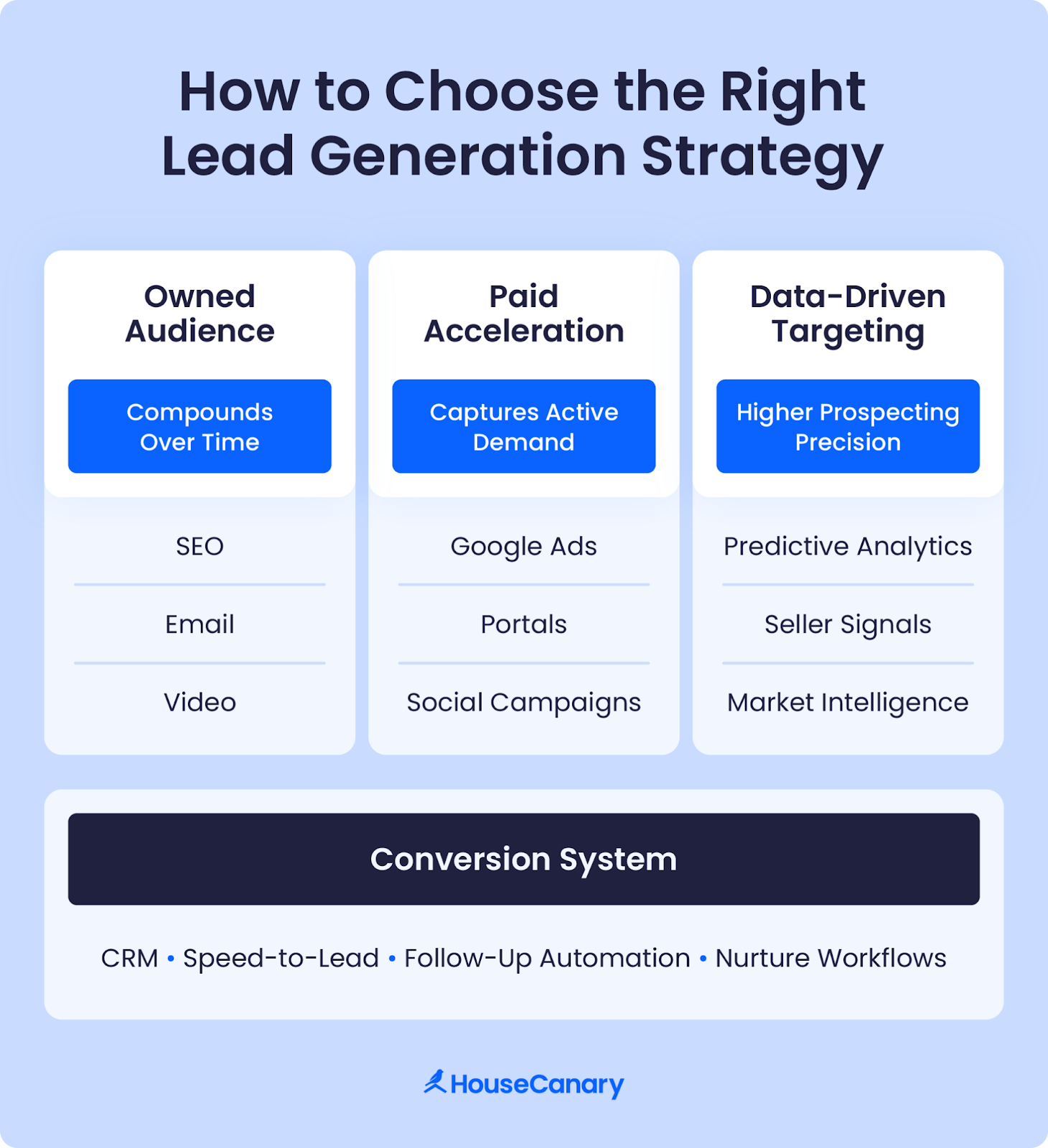
The strongest lead-generation strategy balances three pillars:
- Owned audience: Database nurturing, SEO visibility, and video content that compound over time
- Paid acceleration: Google Ads and portal exposure to capture active demand
- Data-driven targeting: Predictive analytics and seller signals that improve prospecting efficiency
Equally important is follow-up. Without structured systems, even high-quality leads lose value. Speed-to-lead and consistent nurture workflows ultimately determine conversion performance.
Over time, these elements should not operate as isolated tactics. The most effective agents connect their lead sources, data insights, and follow-up systems into a repeatable framework that continuously generates opportunities.
Build a Lead Engine That Actually Works
Sustainable pipeline growth rarely comes from a single tactic. Agents who build durable performance combine owned visibility, paid demand capture, outbound prospecting, and predictive data into a system that improves consistency.
When lead acquisition and follow-up operate together—supported by strong market intelligence—conversion becomes more predictable and less reactive.
The best lead generation for realtors is not defined by volume alone, but by how effectively each strategy identifies and converts high-probability opportunities. Get started with HouseCanary today to strengthen your targeting, pricing, and prospecting.
Frequently Asked Questions
What Is the Best Way to Generate Leads for Real Estate?
The most effective approach combines multiple channels rather than relying on a single source. Strong strategies typically layer inbound visibility (SEO, content, reviews), targeted paid campaigns, and structured outbound prospecting.
Agents who pair acquisition tactics with predictive property insights and consistent follow-up systems tend to build more stable, conversion-ready pipelines.
Are Buying Real Estate Leads Worth It?
Purchased leads can deliver immediate volume, but results vary based on competition, exclusivity, and follow-up speed. For many agents, buying leads works best as a supplement rather than a primary growth strategy.
Long-term performance often improves when agents balance rented lead sources with owned audience-building and data-driven targeting, reducing wasted spend.
How Much Commission Does a Realtor Make on a $300,000 House?
Commission structures vary by brokerage, market, and agreement, but residential transactions typically range from 5–6% of the sale price, split between the listing and buyer sides.
On a $300,000 property, the total commission may range from $15,000 to $18,000 before brokerage splits, referral fees, and expenses. Actual earnings depend on the agent’s compensation model.
What Is the 3-3-3 Rule in Real Estate?
The 3-3-3 rule is a productivity framework used by some agents to maintain consistent pipeline activity.
While interpretations vary, it often refers to contacting three people daily, attending three relationship-building activities monthly, and publishing three pieces of visibility-driven content each week.
The principle emphasizes steady engagement rather than sporadic bursts of prospecting.