

Table of Contents

HouseCanary
Know what any property is really worth.
AVMs with a 2.7% median error, plus the comps and forecasts agents and investors rely on.
Explore PlansOn paper, your investment criteria seem clear. Then you’re faced with two rental properties, one cheaper with lower rent and one pricier with better income. Suddenly, the “right” choice isn’t obvious anymore.
Cap rate, short for capitalization rate, is a key metric for measuring a property’s income potential. It shows how much return a property could generate relative to its value.
Let’s break down the cap rate formula, explain how to calculate cap rate step by step, and walk through examples to show how investors use cap rates to make data-driven decisions.
Key Takeaways
- Quick measure of return: Cap rate shows how much income a property generates each year compared to its price.
- Risk and market signal: Higher cap rates can indicate higher risk or undervalued markets, while lower cap rates often point to stable, in-demand areas.
- Best used with other metrics: For a full picture of performance, consider cap rate alongside other data-backed indicators.
What Is a Cap Rate?
A cap rate puts a property’s earnings into perspective by comparing its income to its value. It helps investors quickly see how much return a property could generate relative to what it would cost to buy.
The cap rate answers a simple question: How much return would this property produce if you bought it in cash? Because it does not factor in financing, the cap rate is considered an unlevered return measure.
This makes it useful for comparing different properties on an equal footing, regardless of how an investor plans to fund the deal. Investors use cap rates to proactively track investment property performance and gauge relative risk.
How to Calculate Cap Rate
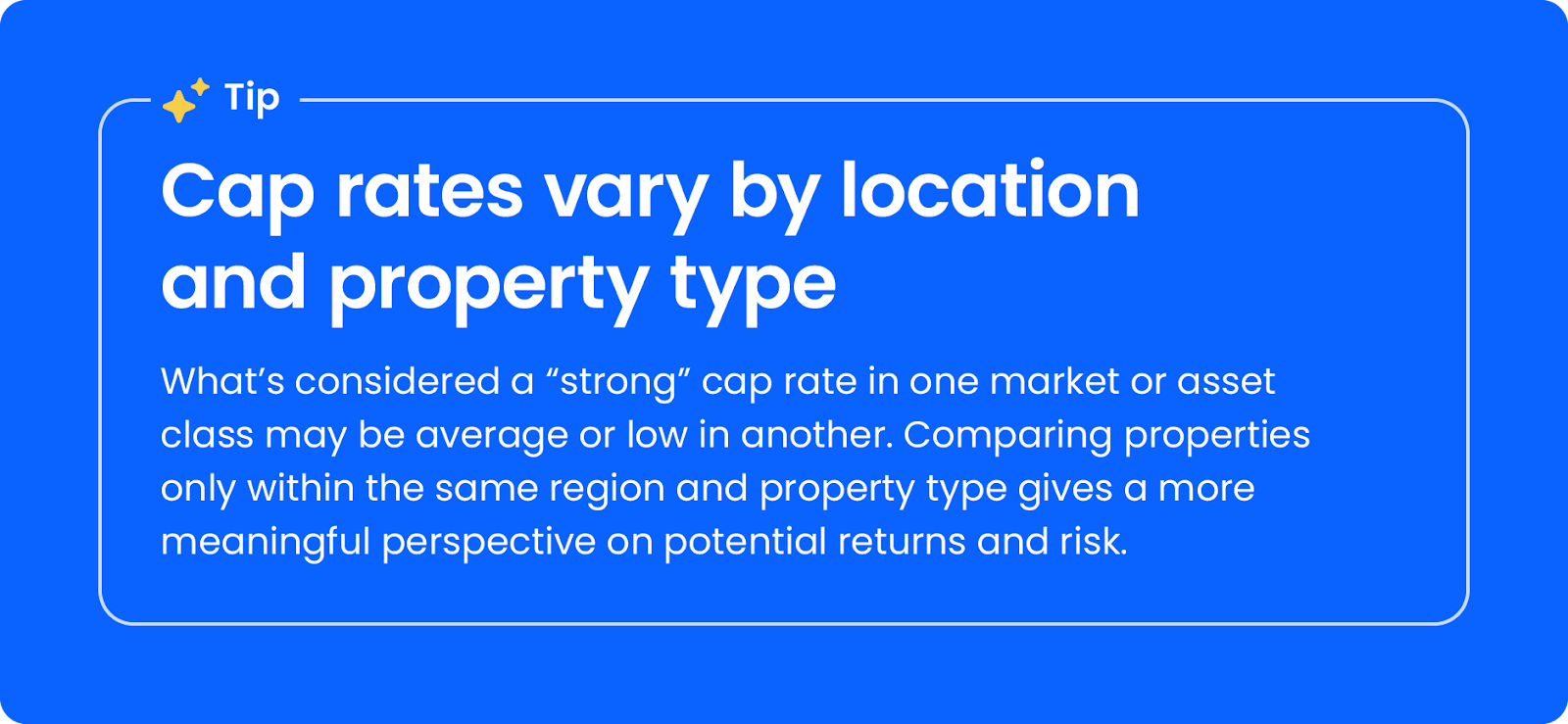
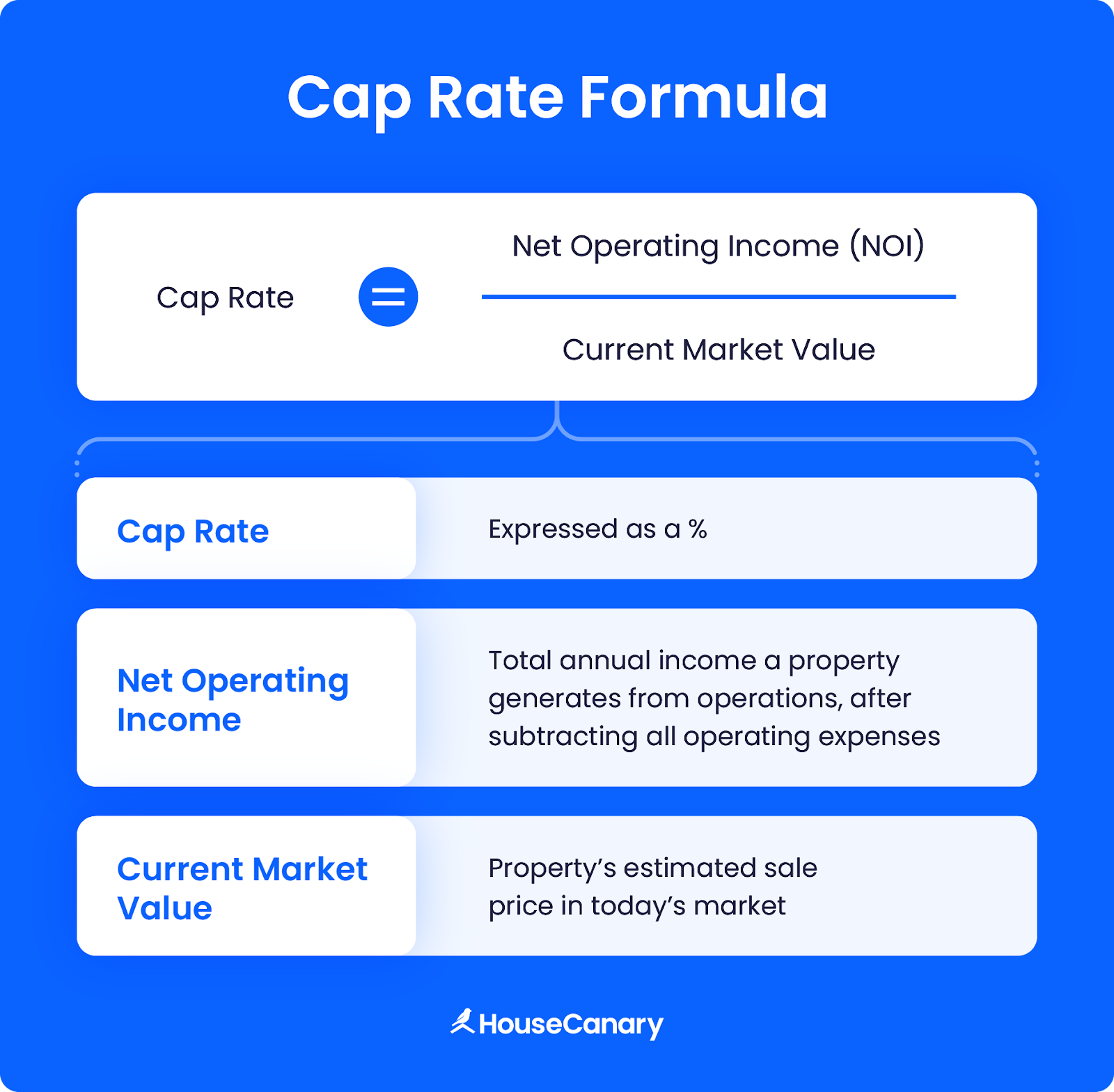
Cap rate is calculated using two main variables: net operating income (NOI) and property value.
NOI represents a property’s annual income after operating expenses, while property value is based on either the purchase price or current market value. Changes in income, expenses, or market conditions can cause the cap rate to shift over time.
Step 1: Calculate Net Operating Income (NOI)
NOI is the profit a property makes from day-to-day operations after expenses, before accounting for financing, taxes, or major upgrades.
NOI Formula: NOI = Gross Rental Income + Other Income – Operating Expenses
Step 2: Determine the Current Market Value
The second part of the equation is the property’s current market value or purchase price. For a property you’re considering buying, this is typically the agreed-upon price. For an existing investment, investors often use an updated market valuation.
Because market value can change over time, the cap rate for the same property may shift even if its income stays the same.
Step 3: Apply the Formula
Finally, divide the NOI by the property’s current market value to find the cap rate. The result is expressed as a percentage, which represents the property’s expected annual return assuming an all-cash purchase.
Cap Rate Examples
Understanding the formula is one thing, but seeing how it works in real investment scenarios makes it much more practical. Below are examples showing how different types of investors use cap rates to evaluate opportunities.
Small Investor: Single-Family Flip Rental
You’re considering buying a single-family home to rent out while you decide whether to hold it long term or sell after appreciation. Before factoring in financing or resale value, you want to know how well the property performs purely as an income-producing asset.
In this case, the property generates a 7.2% annual return based solely on its operating performance and value. An investor could use this figure to compare similar homes in the area or weigh this rental against other investment opportunities.
![Example cap rate calculation for a small investor’s single-family flip rental]](/images/698cd570881428d3dd154087_c7af22fd.png)
Loan Officers/Brokers: Mid-Sized Multifamily Investment
In this example, you’re helping a client secure financing for an 8-unit apartment building. Before discussing hard money loan terms or other financing options, you want a quick way to evaluate how the property performs as an income-producing asset.
The property generates an 8.5% cap rate, giving you a snapshot of its return. For loan officers and brokers, this helps frame financing decisions by informing loan-to-value ratios, interest rate risk pricing, and how comfortably the property’s income can support debt payments.
![Example cap rate calculation for a loan officer/broker’s mid-sized multifamily investment]](/images/698cd570881428d3dd154084_2a844813.png)
Real Estate Agents: Residential Listing
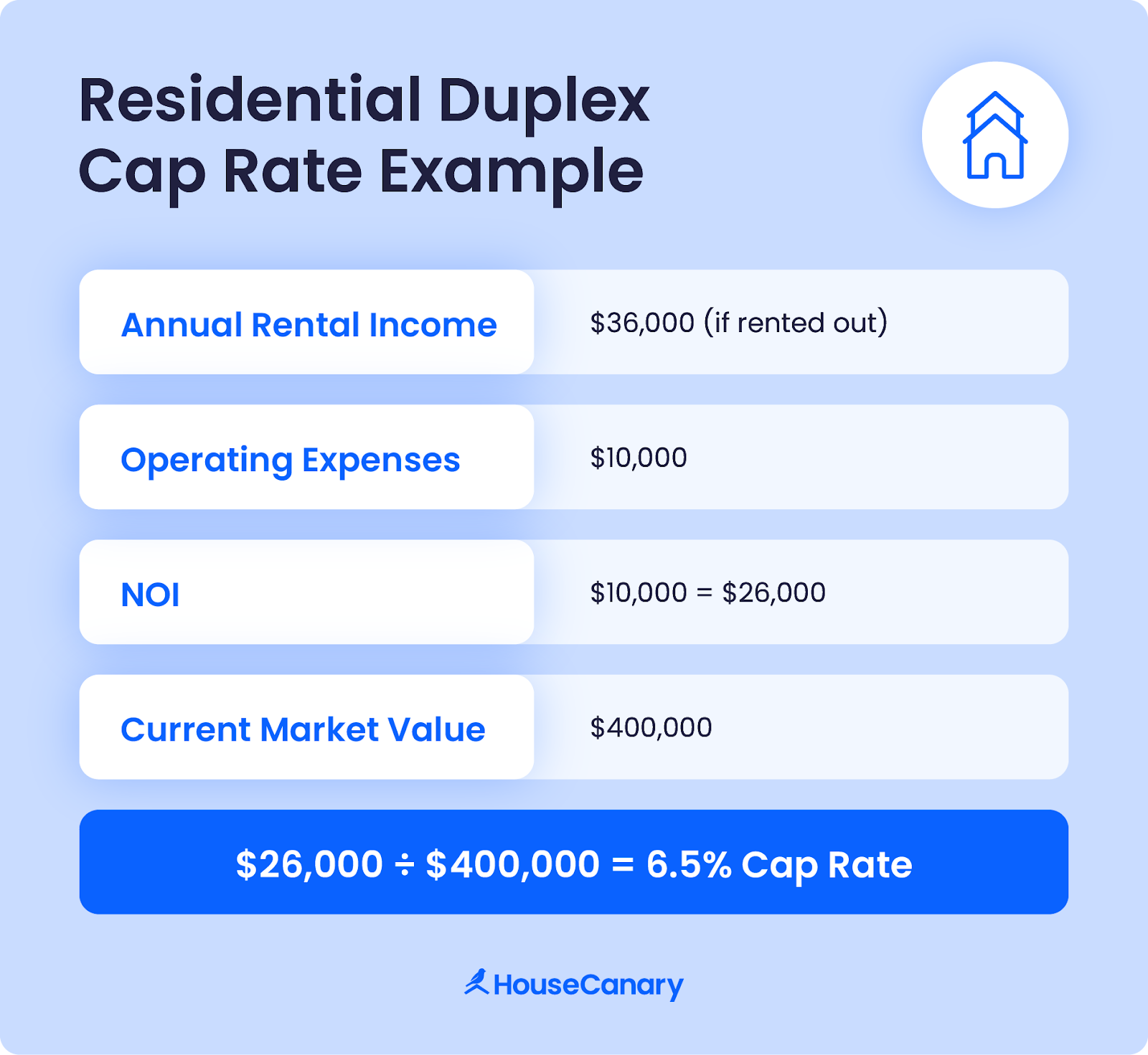
This time, you’re listing a duplex for a client in a desirable neighborhood. Beyond highlighting location and features, you also want to show how the property performs as a potential income-producing asset for buyers considering renting out one or both units.
The property shows solid income potential at a 6.5% cap rate, helping agents position the listing. Lower cap rates in high-demand areas signal stability and long-term appreciation, while higher cap rates appeal to investors seeking immediate cash flow.
What Cap Rates Tell Investors
Cap rates do more than show a property’s unlevered return; they provide a quick look into investment potential and risk. Cap rates turn raw income and value numbers into a quick snapshot of which investments actually perform.
They also help gauge market attractiveness. Higher average cap rates may indicate higher risk or undervalued markets, while lower cap rates often signal stable, in-demand areas.
For a deeper analysis, cap rates are often considered alongside other metrics like rental yield, cash-on-cash return, and ROI. This gives investors a more complete picture of potential performance before locking down a property.

Which Economic Factors Influence Cap Rates
Cap rates are shaped by economic conditions that affect property values and expected returns. Key factors include:
- Interest rates: Higher rates generally push cap rates higher, as investors demand stronger returns to offset increased borrowing costs.
- Unemployment rates: Higher local unemployment can reduce rental demand, putting upward pressure on cap rates.
- Rental growth trends: Strong rent growth can lower cap rates by boosting income potential relative to property value.
- Supply and demand dynamics: Markets with limited inventory or high demand often see lower cap rates, while oversupplied areas may have higher cap rates.
Understanding these factors helps investors interpret cap rates in context and make more informed comparisons across the hottest areas for investors.
Use HouseCanary to Evaluate Property Returns
Cap rate is a powerful metric, but its value depends on accessing accurate, context-rich data to evaluate and compare properties effectively. HouseCanary equips investors with detailed rental valuations, property value forecasts, and market trends so that you can compare opportunities across neighborhoods and property types.
Get started with HouseCanary today to turn complex property data into clear insights.
Frequently Asked Questions About Cap Rates
What Is a Good Cap Rate?
There’s no “good” cap rate. It depends on property type, location, and market conditions. Higher cap rates may offer higher returns but more risk, making them ideal for investors with high risk tolerance seeking cash flow in emerging markets.
Lower cap rates often reflect stability in desirable areas, which can suit investors focused on long-term appreciation and lower-risk holdings.
Are ROI and Cap Rate the Same Metric?
No, cap rate measures the unlevered return on a property’s value, while ROI can factor in financing, taxes, and appreciation, giving a broader view of overall investment performance.
How Often Should Investors Check Cap Rates?
Investors should review cap rates whenever evaluating a property or market, and periodically for existing holdings, especially when income or market values change. Tracking cap rates helps identify shifts in potential returns and compare properties more accurately as market conditions and risks evolve.