Cities Vs. Suburbs: America’s Fastest-Growing Home Prices In 2026, Mapped

HouseCanary



HouseCanary
AVMs with a 2.7% median error, plus the comps and forecasts agents and investors rely on.
Explore PlansToday's housing market is a tale of two cities. While some of the hottest U.S. ZIP codes are in well-known luxury urban markets, many are in up-and-coming suburbs that tick every box on a homeowner's wishlist.
To find out how homebuyers are making the age-old choice of suburbs versus cities in 2026, we dug into HouseCanary's programmatic data. This revealed the ZIP codes with the fastest-growing home prices in the country. On top of that, we polled more than 1,000 homebuyers on how they choose where to live.
The resulting data shows that home values are increasing the fastest in popular urban markets, but many Midwest and Northeastern suburbs are gaining steam, too.
For decades now, metropolitan areas have been growing. Developers are rapidly building new housing developments, and city borders are scooping up neighboring towns. This is all to accommodate people who want the space and comfort of suburban life, without the higher crime rates, cost, and other realities of city living.
Today, we found that homebuyers still say they prefer suburbs, even as the country debates 15-minute cities and as urban crime drops nationwide.
According to our 2026 City Comeback Survey, more than half (55%) of homebuyers who plan to buy a home within the next three years prefer a home in the suburbs. Specifically, 29% would prefer the inner suburbs, which tend to be closer to cities with some transit access, and 26% would prefer traditional suburbs. Another 26% would prefer a small town or rural area.
Only 18% would prefer to buy downtown or in a central neighborhood.
There are a few main factors driving the desire to live near a city, but not in one:
Using HouseCanary's Home Price Index data, which delivers ZIP code-level price forecasts across 136 million U.S. properties, we examined which ZIP codes are seeing the fastest-rising home prices. Despite U.S. residents saying they value affordable suburbs, several of the most desired ZIP codes today are in inner-city neighborhoods that are already known for sky-high prices.
The top metros and top ZIP codes in our ranking tend to fall in two categories. The first is highly desirable urban neighborhoods, like the Lakeview neighborhood in Chicago. The other category is family-friendly suburbs near mid-sized cities, like Rochester, Michigan, a Detroit suburb.
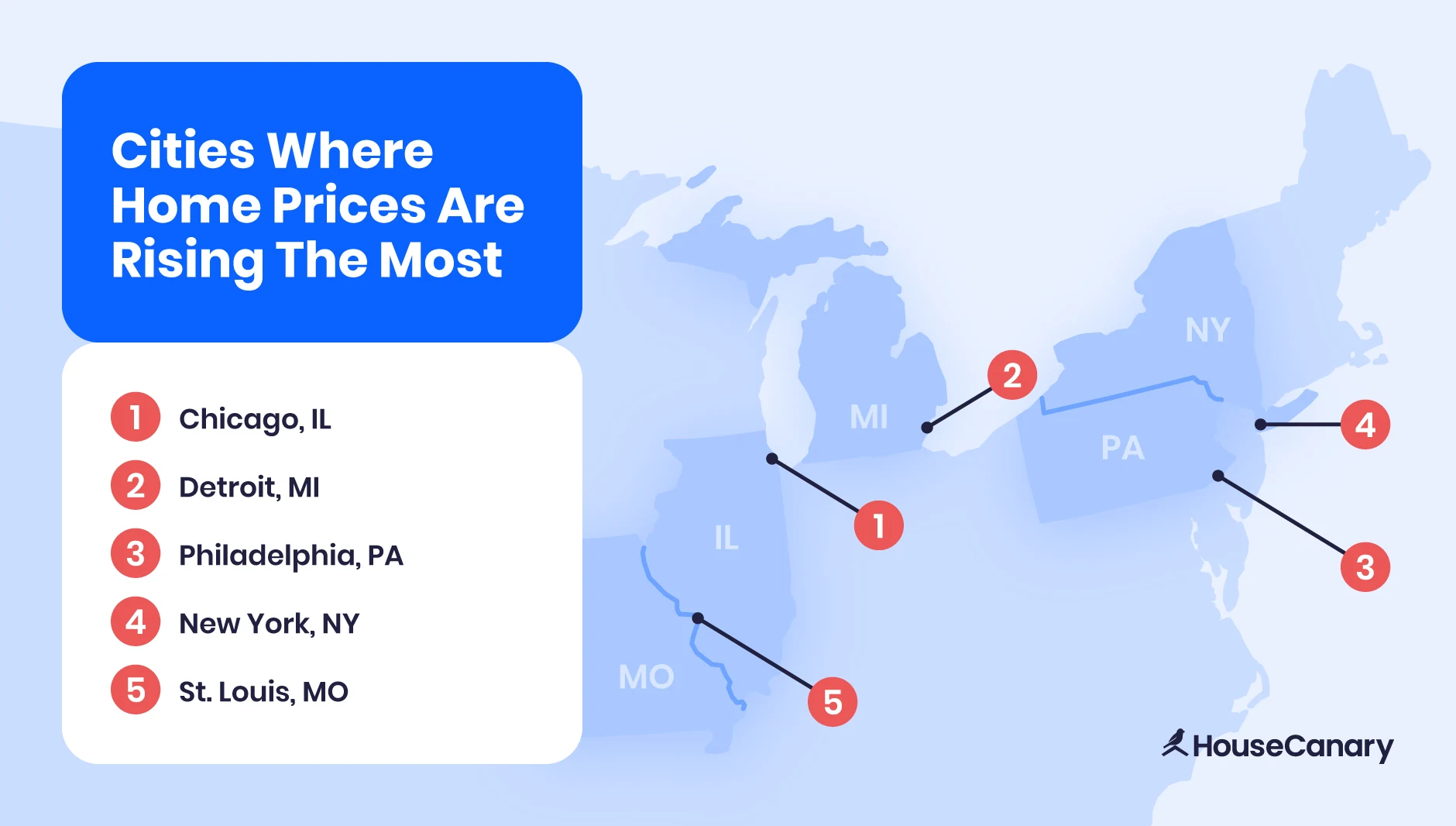
All in all, homes in Chicago, Detroit, and Philadelphia rose in price the most over the last year. What's more, we expect home prices will grow more in those cities in the next year than elsewhere in the U.S.
The resulting picture shows two types of American homebuyers: One is eyeing a home in a trendy urban neighborhood, where prices are high and growing higher, but they can afford the squeeze. The other is looking for a safe, amenity-rich suburb, where they can afford a larger home for less than they would have paid in the city.
The top ZIP codes in each of our top cities include the Lakeview neighborhood in Chicago and the Upper West Side neighborhood in Manhattan, indicating some still want homes in the country's most desirable neighborhoods — if they can afford it.
Still, many top ZIP codes are in suburbs with low crime rates and top-rated school districts. They are also relatively walkable and amenity-rich, which is appealing to families who want the access of a city, without the drawbacks.
The top ZIP code on our list is 60657 in the Chicago metro area. Home prices increased 9.35% YOY between 2025 and 2026, and HouseCanary projects they will increase another 6% in the next 12 months — the fastest growth of any ZIP code HouseCanary tracked.
This ZIP code is in the Lakeview and Lincoln Park neighborhoods, two of the wealthiest and most desirable neighborhoods in Chicago.
The Windy City leads the nation in rising home prices overall. Not only is it the top metro, but the top 13 ZIP codes in our list are all in the Chicagoland area.
The top ZIP code in the Detroit area is 48307, which includes the suburbs of Rochester, Michigan, and parts of Rochester Hills nearby. It has the fastest-growing home prices of any U.S. suburb, second only to 60402, which includes Berwyn, Illinois, outside of Chicago.
Rochester is considered one of the best places to live in the Detroit area, with a highly rated school district and a lower crime rate than in the city. Despite being a suburb, it's also considered relatively walkable, especially downtown.
The top ZIP code in the Philadelphia area is 19149, which covers the working-class neighborhoods of Mayfair and Summerdale.
Despite being inside Philadelphia proper, these neighborhoods tend to have a more suburban feel, and the affordable home prices may be appealing to families and working-class Philadelphians who want to stay inside the city.
These neighborhoods are a contrast to some of the top ZIP codes in the Chicago, New York City, and Detroit areas, which already tend to have home prices higher than the national average. Instead, this ZIP code might be more appealing to families looking for a starter home or investors looking for an up-and-coming neighborhood.
The top ZIP code in the New York City metro area is 10025, which includes the Upper West Side neighborhood in Manhattan. Despite only having an area of 0.75 square miles, it's very dense, with a population of 97,373.
The Upper West Side is one of the most desirable neighborhoods in New York City, with an average home price already well over $1 million.
The top ZIP code in the St. Louis metro is 63122, which covers the small inner suburb of Kirkwood, Missouri. Like other fast-growing suburbs, Kirkwood is less dense than comparable urban areas, but homes are sold quickly.
Kirkwood is widely considered a great place to live in Missouri for its excellent school district and family amenities, including parks and restaurants. It also has train access and is considered relatively walkable.
Of the top 500 ZIP codes on our list, more than half have home prices that are actually falling YOY. Most will continue to see home prices fall over the next 12 months.
The five metros with home prices falling the fastest are all in Texas and Florida. Many metros in these areas, like Austin, Texas, saw home prices explode over the past few years, but prices are falling due to a combination of local affordability initiatives and cooling interest.
In the Tampa-St. Petersburg-Clearwater metro, home prices fell 4.34% YOY, the fastest slump in any U.S. city by a considerable margin.
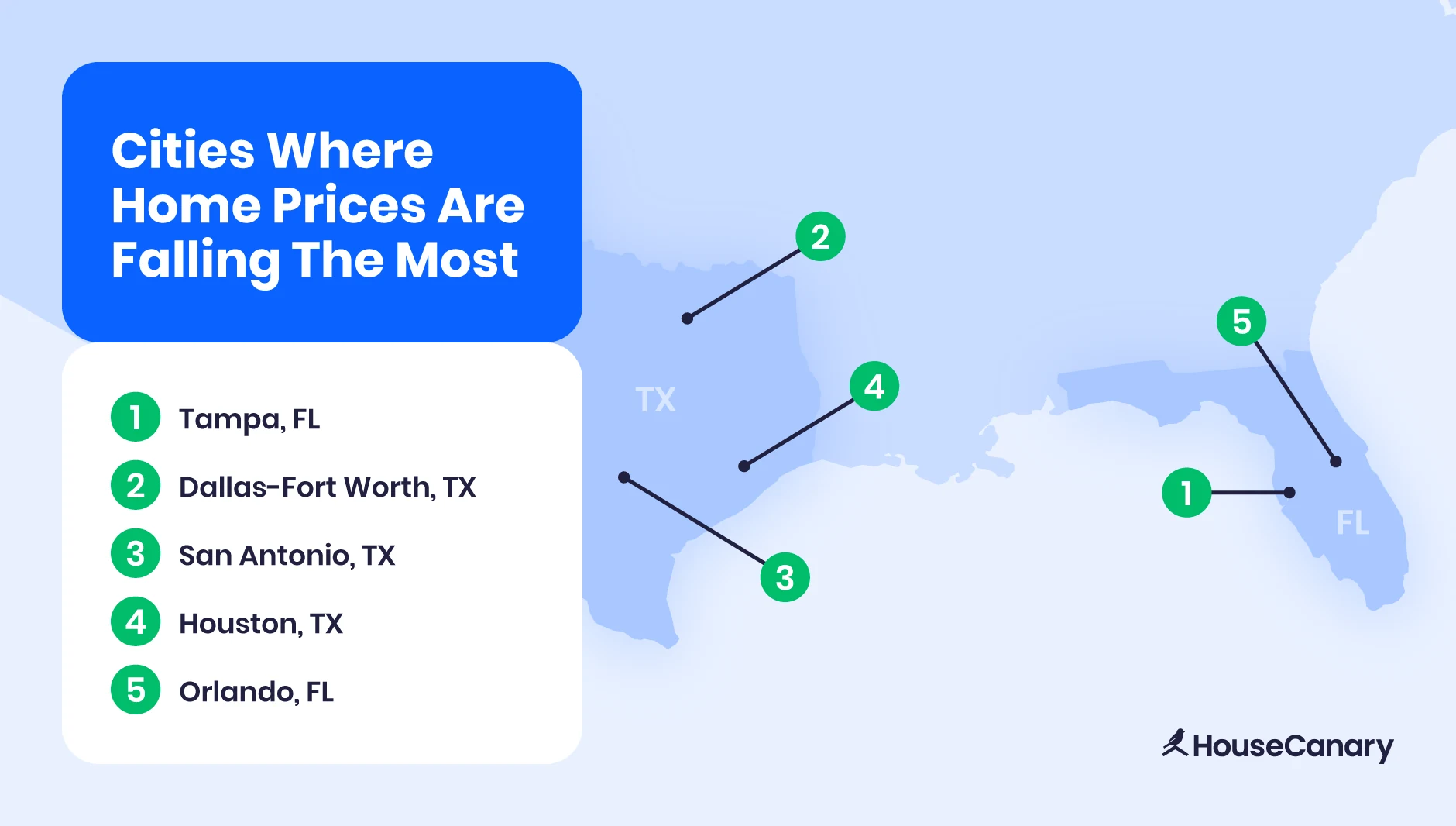
Home prices fell the fastest of any U.S. ZIP code in 78207, the San Antonio-New Braunfels metro area in Texas.
This area covers a portion of the West Side, a neighborhood about 30 minutes from downtown San Antonio. It's relatively densely populated, with 7,431 people per square mile, with a higher crime rate. This is consistent with other ZIP codes where home prices are falling quickly, which tend to have higher crime rates and fewer local amenities.
HouseCanary gives you the most up-to-date data on the housing market, but more importantly, it also gives you the tools to know what steps to take next.
CanaryAI, HouseCanary's next-generation AI platform, is designed to help real estate professionals make faster, smarter, and more confident decisions. CanaryAI uses everything from local property conditions to real-time forecasting to give hyper-local data on the rapidly evolving housing market.
Explore HouseCanary's platform options today to stay ahead of the market and make smarter decisions.
The survey was conducted by Centiment on Jan. 13–Jan. 18, 2026. It polled 1,045 U.S. adults who plan to buy a house now or in the next 1–3 years. Data is unweighted, and the margin of error is approximately ±3% for the overall sample at a 95% confidence level.
HouseCanary's AI-driven Home Price Index (HPI) forecast is built from 136 million verified property records, transaction histories, and market indicators across the U.S. The model evaluates trends in pricing, supply, demand, and local fluctuations to predict home value movements at the ZIP code level over a 12-month horizon.

Streamline your portfolio management with automated updates that ensure you're always in the know.


We build groundbreaking technologies to improve and accelerate residential real estate operations.