
Table of Contents

HouseCanary
Know what any property is really worth.
AVMs with a 2.7% median error, plus the comps and forecasts agents and investors rely on.
Explore PlansAs affordability pressures persist and family structures evolve, more Americans are combining multiple generations under one roof. In 2025, 17% of homebuyers purchased a multigenerational home.1 These households show higher stability, with 74% of multigenerational households owning their own home in 2022, underscoring their growing influence on the housing market.2 But whether families can actually live together depends far more on how homes are built—and where.
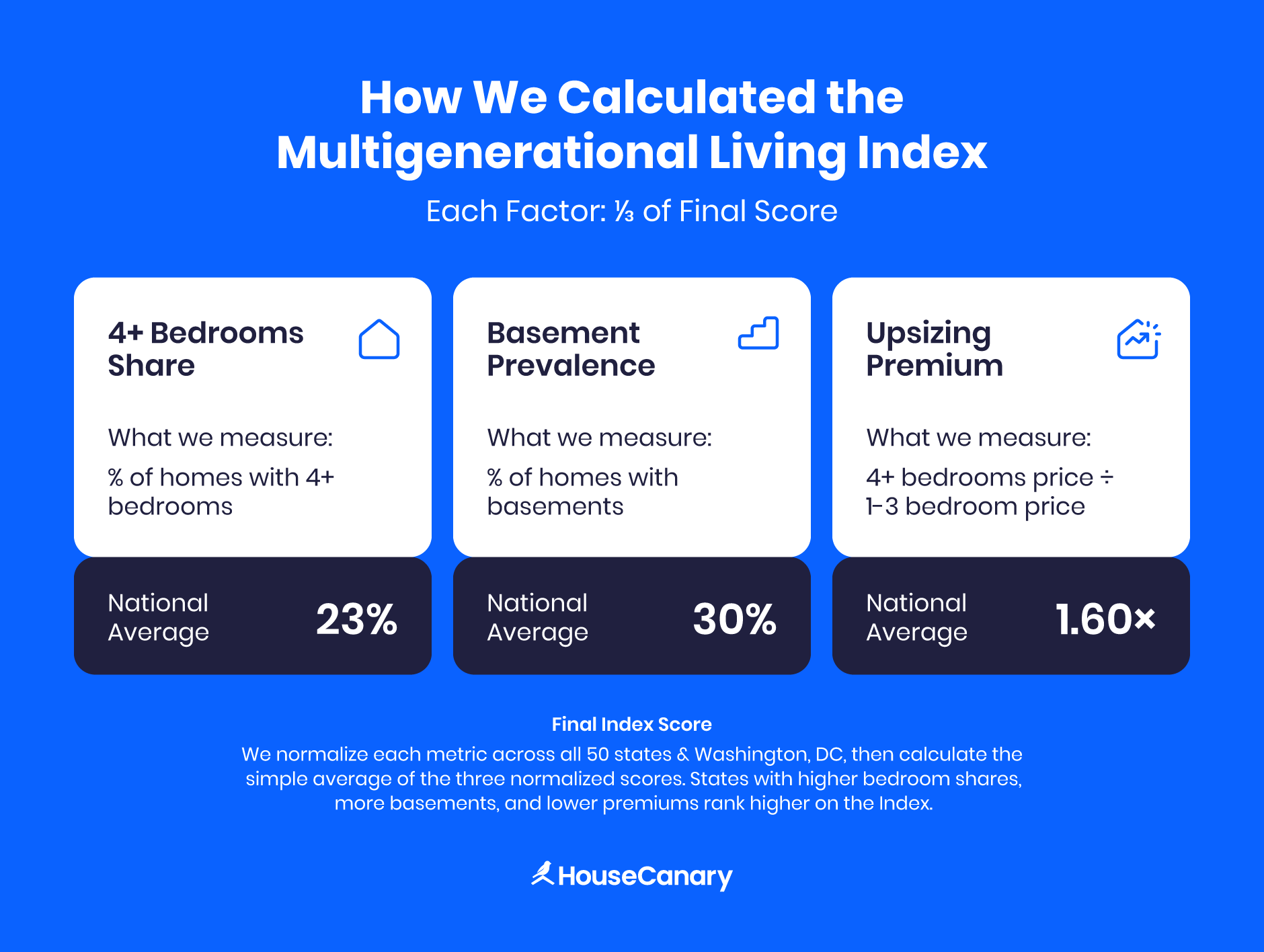
Nationally, new HouseCanary data shows that just 23% of homes have 4+ bedrooms, and only 30% include basements—two features that often determine whether multiple generations can share a home without major tradeoffs. Upsizing also adds cost. The average 4+ bedroom home costs about 1.6× as much as a 1–3 bedroom home, making flexibility far more expensive in many markets.
To identify where multigenerational living is most viable today, HouseCanary created the Multigenerational Living Index as part of its broader market analysis of housing supply and pricing. Using proprietary data, the Index shows which states are structurally prepared for this shift—and which remain constrained despite rising demand.
Key Takeaways
- Utah ranks No. 1 for multigenerational flexibility: 41% of homes offer 4+ bedrooms (compared with the national benchmark of 23%), and 53% of properties report having basements.
- Basement‑heavy states such as Minnesota and Ohio rank near the top of the Index: Minnesota combines a 29% 4+ bedroom share, 65% basement prevalence, and a 1.44× premium for a 4-bed home, while Ohio offers 24% 4+ bedroom share, 71% basements, and a 1.56× premium.
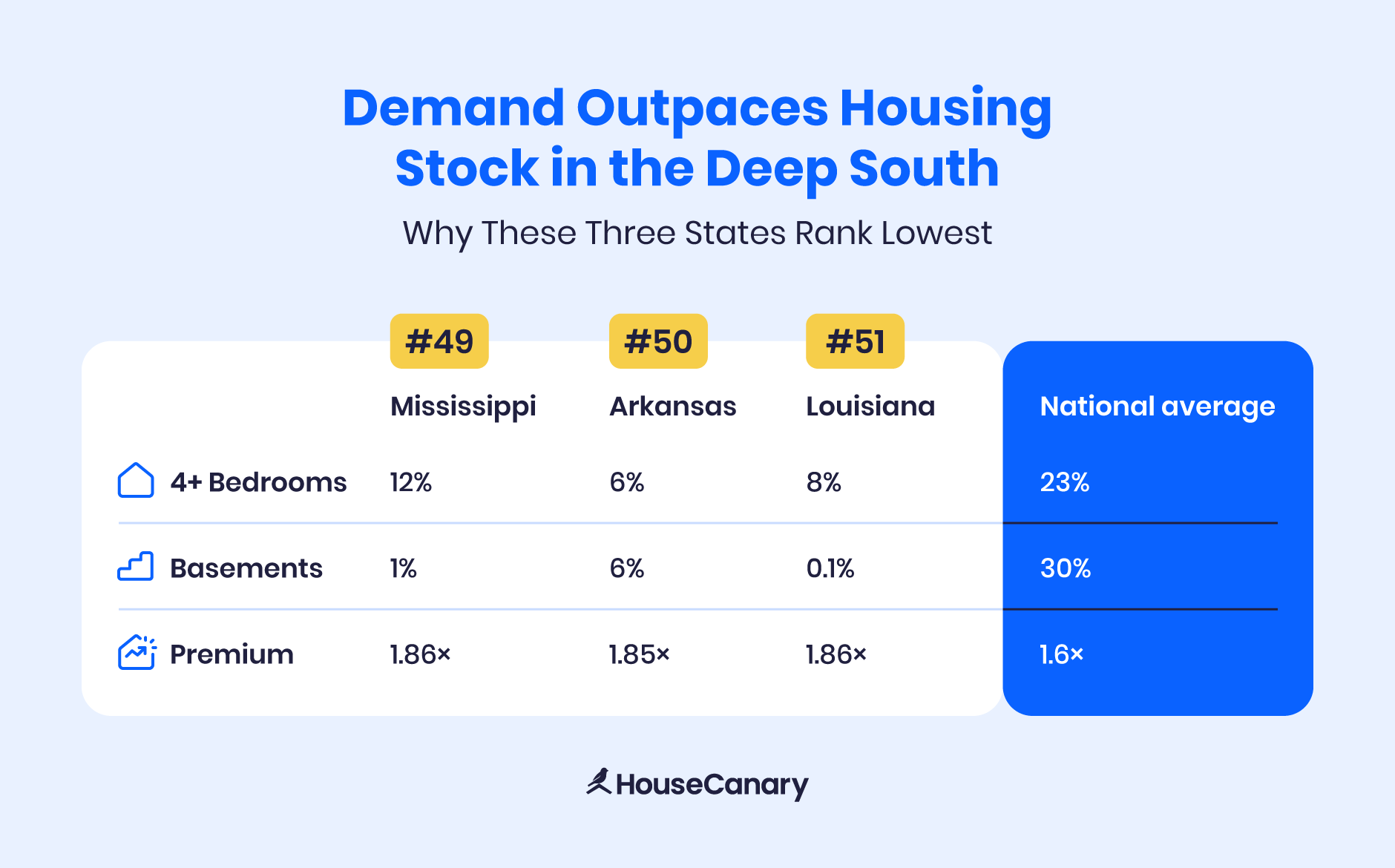
- Deep South states sit at the bottom of the Index, with low 4+ bedroom shares, almost no basements in Louisiana (0.1%), and steep 4‑bedroom premiums of about 1.86×.
Utah Ranks No. 1 for Multigenerational Living, with 41% of Homes Offering 4+ Bedrooms
The Mountain West stands out as the clearest example of housing stock keeping pace with multigenerational demand. Utah ranks No. 1 on HouseCanary’s Multigenerational Living Index, driven by an unusually high share of large homes and widespread basement availability.
More than 41% of Utah homes offer 4+ bedrooms, nearly double the national benchmark, while 53% report basements. This gives households more opportunities to carve out additional living space. Crucially, the cost of upsizing remains relatively contained, with a 4-bedroom price premium of about 1.39×—far below the national average.
That balance between space and affordability extends across the Mountain West. Colorado, Idaho, and Wyoming all rank in the top five on the Index, each exceeding the national benchmark of 23% for 4+ bedroom homes and 30% for basement prevalence.
For multigenerational buyers, this means homes in the Mountain West are more likely to include extra bedrooms or convertible basement space from the start. This reduces the need for costly renovations.
These markets are seeing stronger buyer activity, with demand rising across price tiers. Housing market forecasts increasingly point to sustained growth in Western states that pair affordability with livability.
Minnesota and Ohio Rank Near the Top, with 65%+ Basement Prevalence
Coastal housing markets often carry an assumption of flexibility. Dense development, higher prices, and progressive housing norms create the perception that these regions are better equipped for multigenerational living. In reality, the data suggests many coastal homes optimize for location and land scarcity, not adaptability.
When families need to share space, structural features matter more than coastal prestige. In many coastal markets, gaining more space often requires purchasing a larger, more expensive home. In basement-heavy states, families can often convert existing space instead.
That dynamic explains why the Midwest and Northeast “basement belt” consistently outperforms several high-priced coastal states on the Multigenerational Living Index.
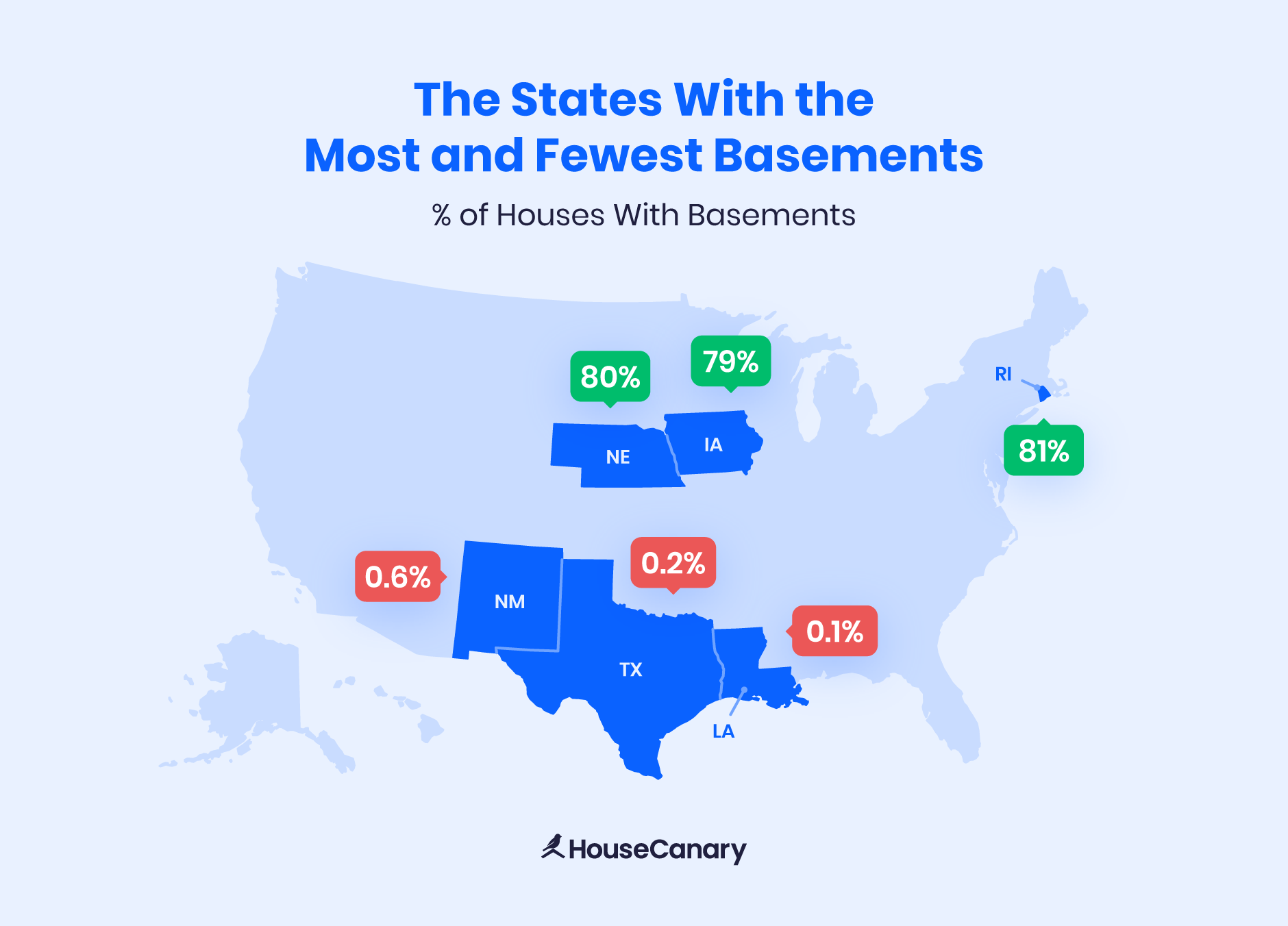
Minnesota combines a 29% share of 4+ bedroom homes with 65% basement prevalence, while Ohio pairs 24% large-home availability with 71% basement coverage. Upsizing is more cost-effective in both states than in many coastal markets, allowing households to add usable space without paying extreme premiums.
Nebraska and Rhode Island further reinforce this pattern. Despite lower national profiles, their housing stock includes extensive basement space (81% in Rhode Island), pushing them ahead of several prestige markets where adaptability is far harder to achieve.
Because basement prevalence is so uneven across regions, it becomes a defining variable in the Index rankings. In high-cost markets where larger homes carry steep premiums, states with widespread basement availability hold a structural advantage. This is reinforced by market pulse data that shows sustained pricing pressure in space-constrained markets.
For builders and investors, that advantage shifts where opportunity lies. In basement-heavy states, meeting multigenerational demand often means finishing or converting existing space instead of building new homes, which costs less and makes better use of what’s already there.
Arkansas, Mississippi, and Louisiana Rank at the Bottom, with 4+ Bedroom Shares Below 12%
The Deep South is defined more by supply constraints than demand. South Carolina, Oklahoma, Mississippi, Arkansas, and Louisiana occupy the bottom of the Multigenerational Living Index, reflecting a structural mismatch between cultural norms and housing stock. Large homes remain scarce across the region, with just 7% of homes in Arkansas, 12% in Mississippi, and 8% in Louisiana offering 4+ bedrooms. Basement availability is even more limited. For example, it’s effectively nonexistent in Louisiana (just 0.1% of properties).
Despite lower absolute home prices, upsizing in these states proves disproportionately expensive. 4+ bedroom homes cost roughly 1.85x–1.86× more than smaller homes in Arkansas, Mississippi, and Louisiana, well above the national average. Without basements or flexible layouts to absorb growing households, families face a choice: pay steep relative premiums, compromise on space, or abandon multigenerational living altogether.
This constraint matters because multigenerational living remains culturally prevalent in the South, particularly among Black, Hispanic, and Asian households.3 The data shows that demand exists, but the housing stock isn’t structurally prepared to meet it.
For buyers, this translates into tougher tradeoffs between affordability, space, and location. For sellers, homes with flexible layouts command outsized value because they are rare. For builders and investors, opportunities exist in new construction, accessory dwelling units (ADUs), and purpose-built multigenerational designs.
Multigenerational Demand Is Rising, but U.S. Housing Stock Remains Constrained
Multigenerational households already account for a meaningful share of home purchases and population growth, yet the national housing stock has not fully adapted to this trend. With only 23% of homes offering 4+ bedrooms and 30% including basements, many families remain constrained by floor plans designed for a different era. As mortgage rates stay high and fewer people are forming new households, the way homes are built increasingly determines where families can realistically buy.
Housing flexibility is becoming a real advantage for buyers, sellers, and investors as they compare markets using a disciplined market selection guide. States that offer adaptable home layouts without steep price increases are better positioned to accommodate demographic shifts highlighted in forward-looking forecasting models, without pushing affordability out of reach.
As affordability pressures continue, tools that surface these dynamics at the state, ZIP code, and neighborhood levels will play an increasingly important role in market decision-making. To explore how these patterns unfold locally, readers can dig deeper with HouseCanary’s data explorer, which brings multigenerational housing signals into sharper focus across markets.
Methodology
The Multigenerational Living Index uses HouseCanary’s internal data to calculate, for each state and D.C., the share of homes with 4+ bedrooms, the share with basements, and the 4‑bedroom price‑premium ratio from the raw data sheet. The final Index score is the simple average of these three normalized values, with all components equally weighted, and states are ranked from 1 (best) to 51 (worst) based on this score.
External Sources
- National Association of Realtors (2025). Baby Boomers Regain Top Spot as Largest Share of Home Buyers.
- National Association of Home Builders (2024). Rising Homeownership Rate for Multigenerational Households.
- Pew Research Center (2022). The demographics of multigenerational households.